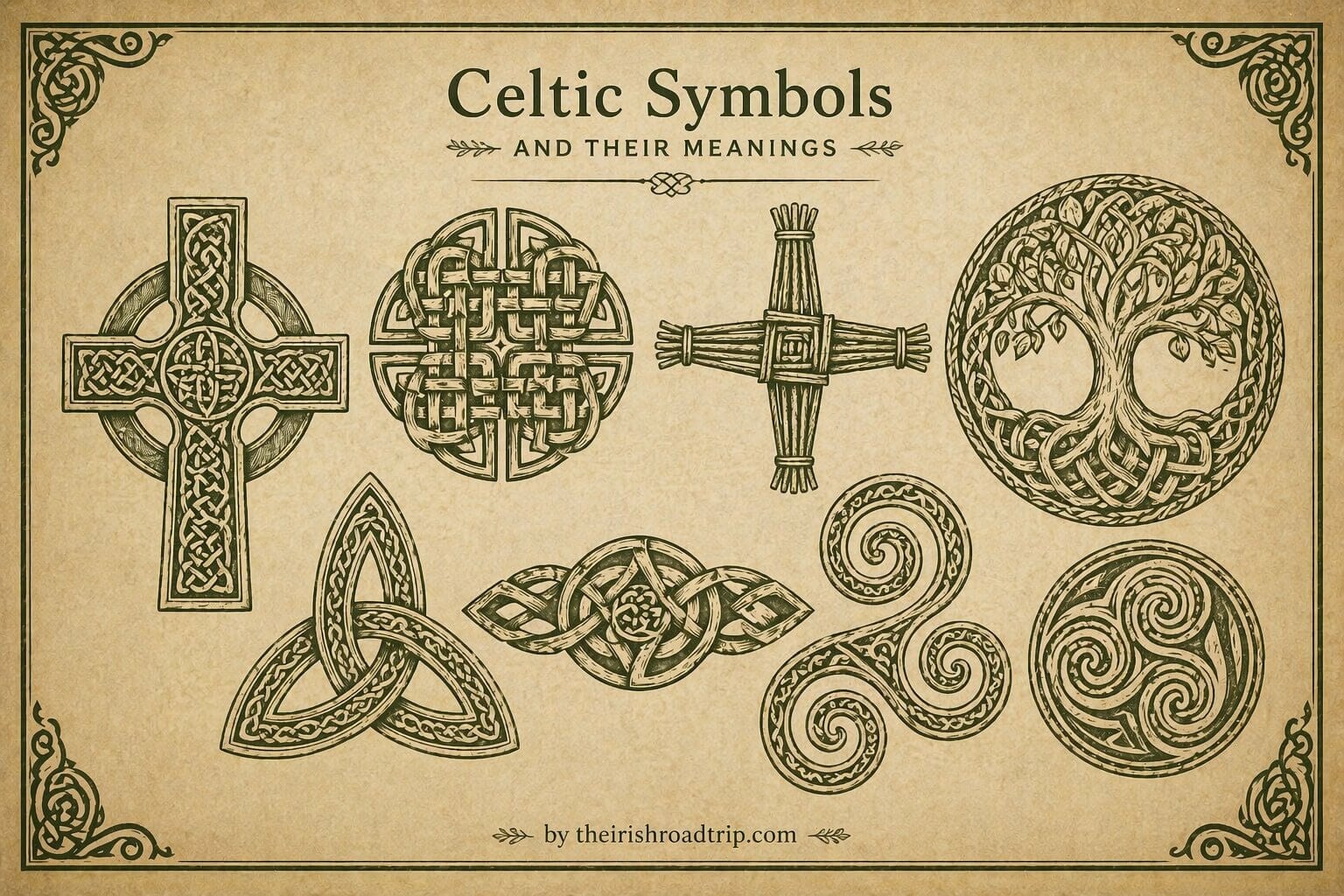
Many ancient Celtic symbols and their meanings are rooted in pre-Christian Europe, long before written records existed. These Celtic designs, carved into stone and later woven into manuscripts like the Book of Kells, reflect how the Celts understood life, death, nature and the spiritual world.
Not to be confused with Irish symbols (like the Claddagh), true Celtic symbols, such as Celtic knots, spirals and early crosses, arrived in Ireland with Celtic culture over 2,000 years ago.
In this guide, you’ll find the main Celtic symbols explained clearly, including what they meant to the Celts, where they came from and how they’re used today. You’ll also see which Celtic designs you’ll find online are modern inventions with no historical basis.
Celtic symbols and meanings explained
Some of the most notable Celtic symbols include the Triskelion, the Celtic Cross, the Triquetra, the Celtic Tree of Life and the numerous Celtic Knots, including the Dara Knot, a symbol of strength.
Many were handed down over time and their meanings were never recorded in writing. However, most of the symbols have been interpreted over the years.
There is a common theme of love, loyalty, strength, unity and religious belief in Celtic symbolism.
The Triskelion
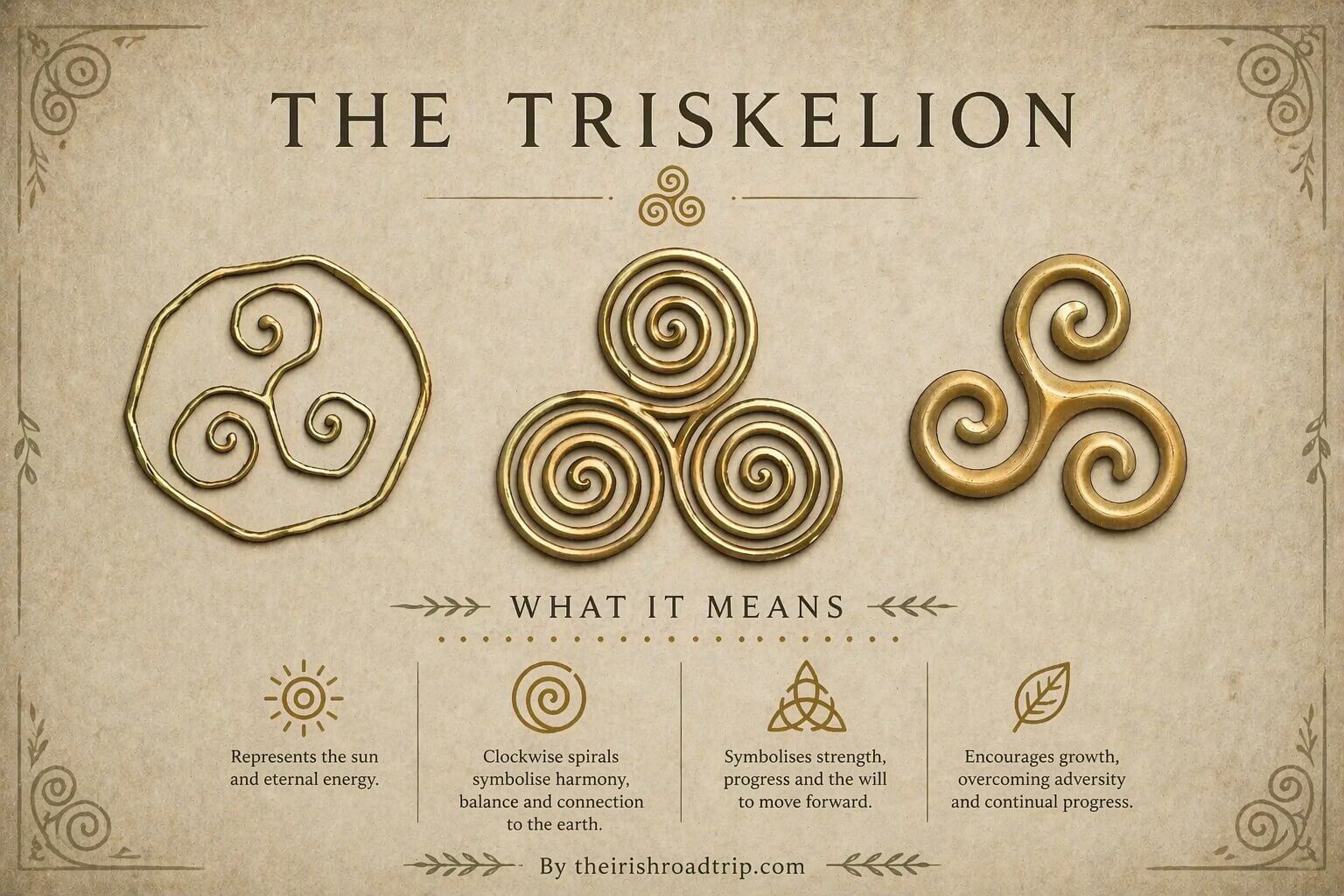
Also known as the Triskele or Triple Spiral, the Triskelion is one of the oldest Celtic symbols, dating back to around 3,200 BC. The name comes from the Greek triskeles, meaning “three-legged”.
It is most famously carved into the entrance stone at Newgrange, a passage tomb built thousands of years before the Celts arrived. Like many early motifs, it was later absorbed into Celtic art and belief.
The design is simple: three spirals radiating from a central point. This Celtic symbol meaning is tied to their tendency to group ideas in threes.
It’s commonly interpreted as life, death and rebirth; past, present and future; or land, sea and sky. What sets the Triskelion apart is its sense of motion.
It looks like it’s turning, which is the point – it represents movement, cycles and the idea of pushing forward rather than standing still.
The Celtic Cross
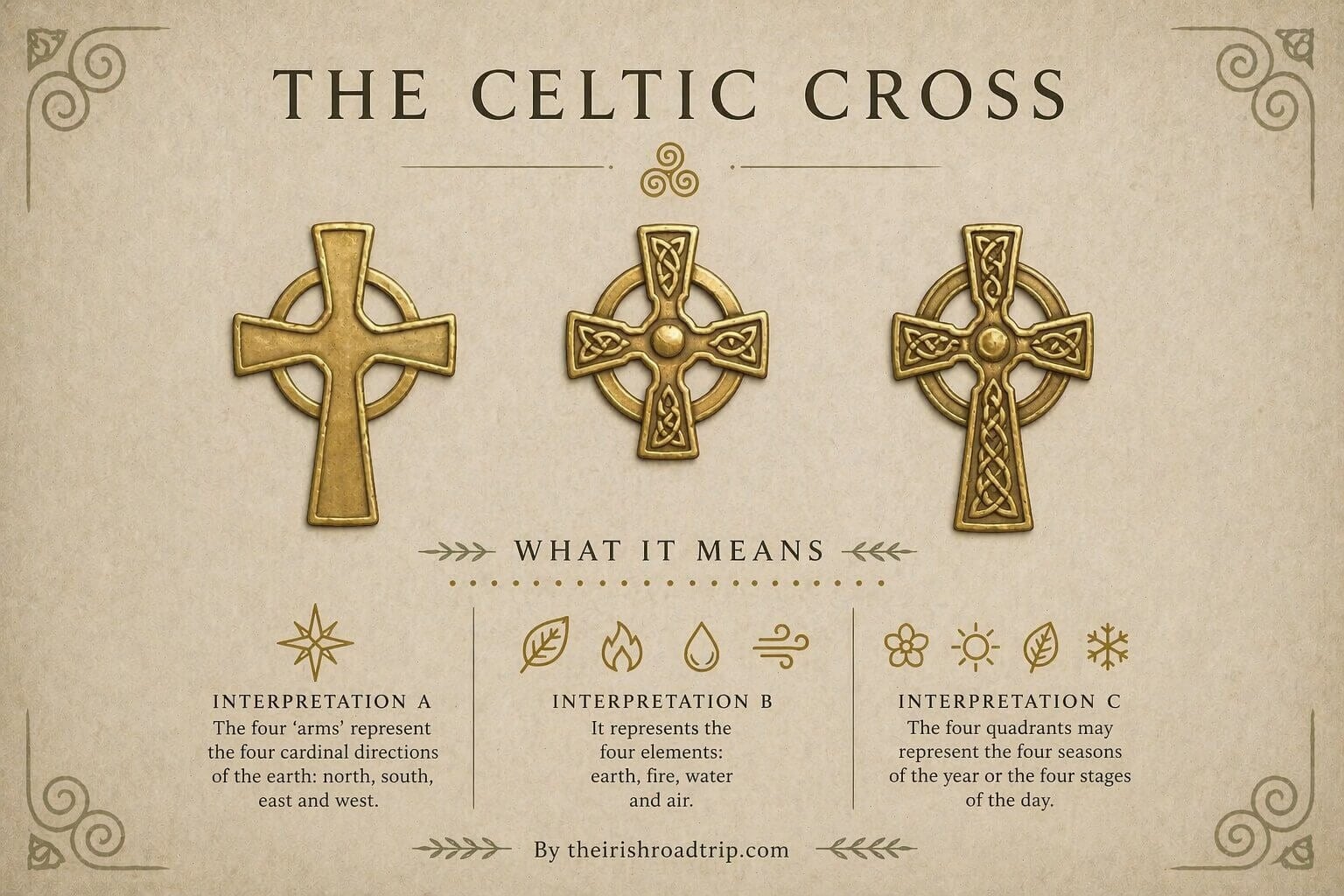
The Celtic Cross has been present in Ireland from the early Middle Ages and it is arguably the most recognisable of the many Celtic symbols.
Some of the earliest Celtic Cross symbols in Ireland date back to the 8th or 9th century and can be found in Monasterboice (Louth) and Kells (Meath).
Originally, these crosses would have been made from wood or metal and they were much smaller than the surviving stone carved pillars that can be found across Ireland.
There are many theories about the meaning of the Celtic Cross:
- Interpretation A: The four ‘arms’ represent the four cardinal directions of the earth (north, south, east, and west)
- Interpretation B: It represents the four elements: Earth, fire, water and air
- Interpretation C: The four quadrants may also represent the four seasons of the year or the four stages of the day: morning, midday, evening and midnight.
The Ailm
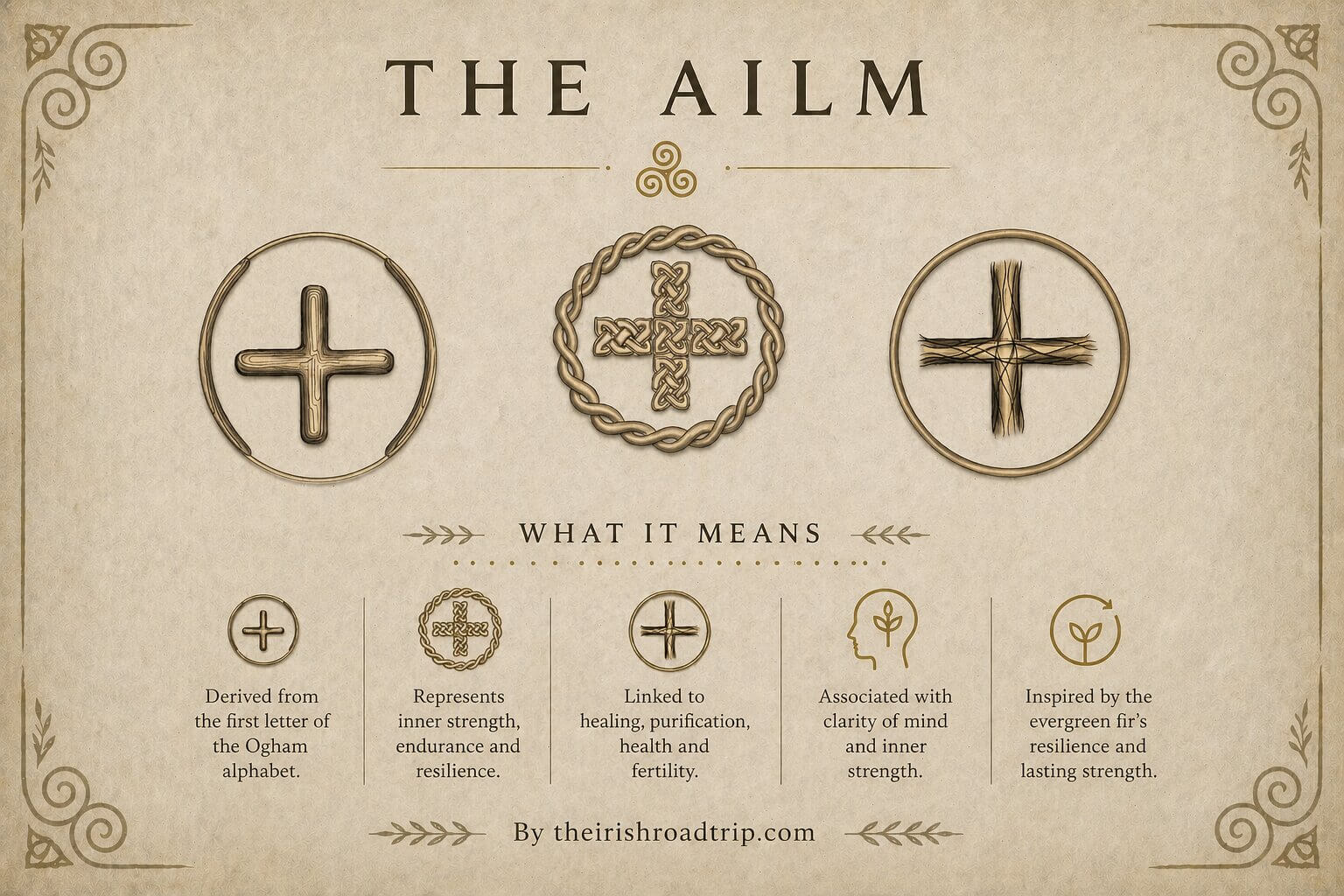
The Ailm is another of the Irish Celtic symbols for strength and is derived from the first letter of the Ogham alphabet.
Ogham was a primitive form of written communication in Celtic history and the Ogham was originally a group of trees that were thought to dispense knowledge and wisdom.
The Ailm is thought to be a type of conifer or silver fir tree. In ancient Celtic tree lore, evergreen fir trees were associated with the healing of a person’s inner soul.
Trees are the most accurate Celtic symbol for strength – an oak can survive and grow in difficult circumstances and can ‘live’ for hundreds of years.
The Wheel of Taranis
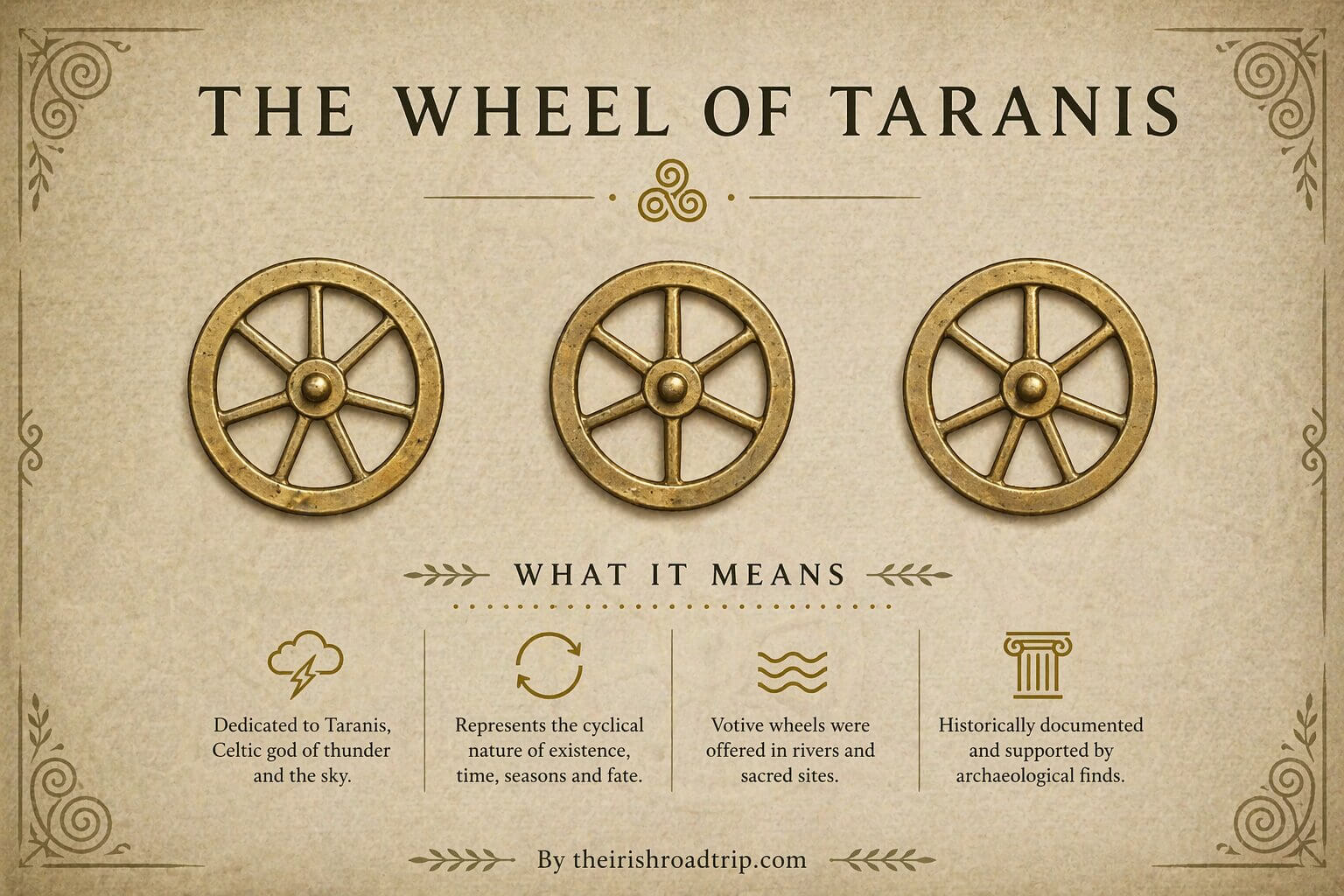
The Wheel of Taranis is one of the most historically grounded of all ancient Celtic symbols, with archaeological evidence placing it firmly in the Celtic Iron Age.
Taranis was the Celtic god of thunder and the sky, a formidable deity worshipped across Gaul, Britain and Ireland, and his symbol was a spoked wheel, typically with six or eight spokes.
The wheel itself is significant. It represents not just Taranis specifically but the cyclical nature of existence – the endless turning of time, seasons and fate.
Votive wheels have been found across Celtic Europe, often deposited in rivers and sacred sites as offerings.
Unlike some Celtic symbols whose meanings have been reconstructed or romanticised over the centuries, the Wheel of Taranis is well documented in classical sources and backed up by physical finds.
The Dagda
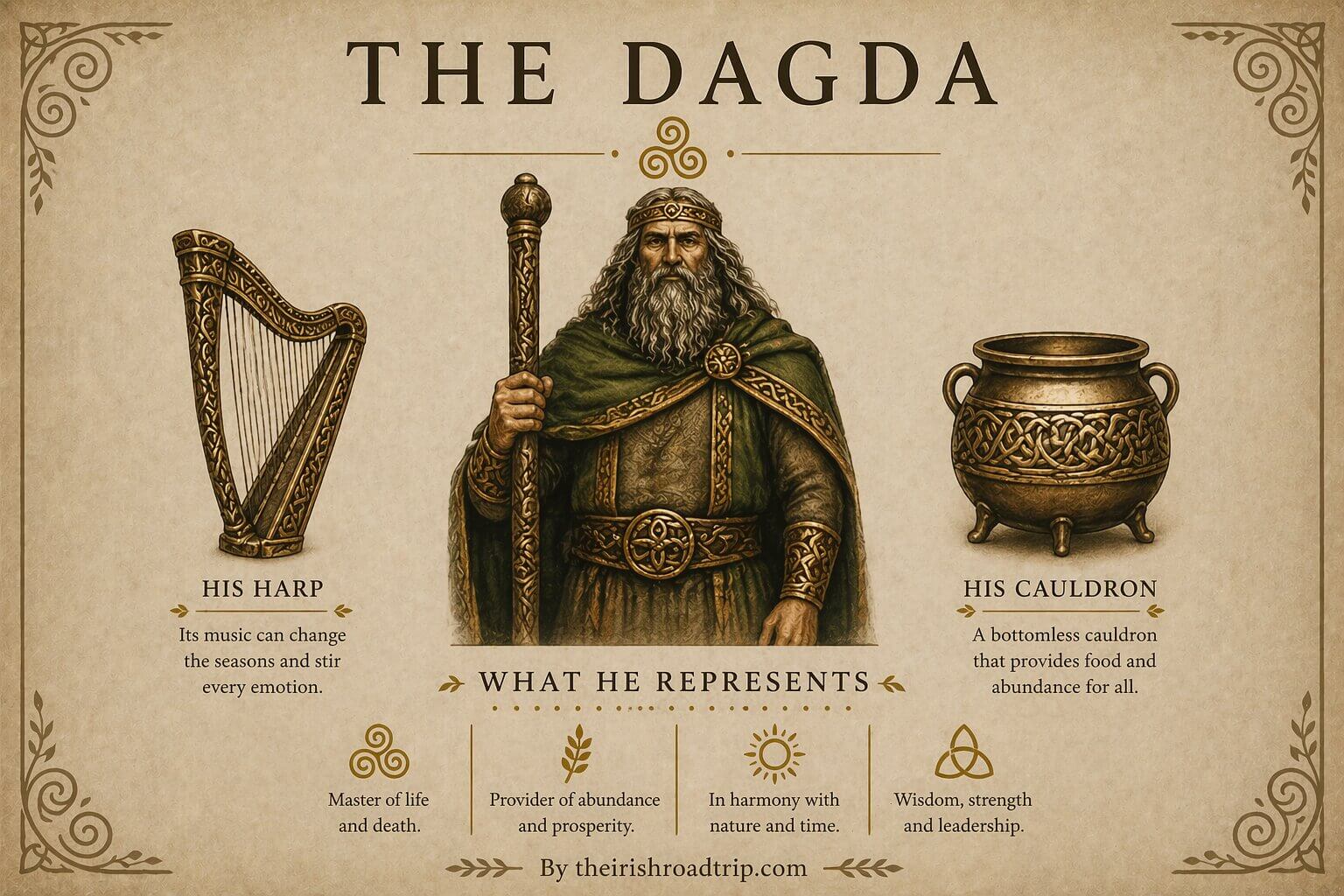
The Dagda is one of the most important figures in Celtic mythology – a chief deity of the Tuatha Dé Danann, the mythological race of divine beings said to have inhabited Ireland before the coming of the Gaels.
He carries three iconic objects: a club said to control both life and renewal; a cauldron that never emptied, representing endless abundance; and a harp that could control the seasons and human emotion simply by being played.
Each of these speaks to the range of his power – life and death, nourishment, and the harmony of the natural world. As a Celtic symbol, the Dagda represents the full weight of masculine divine power in Celtic tradition.
The Solar Cross
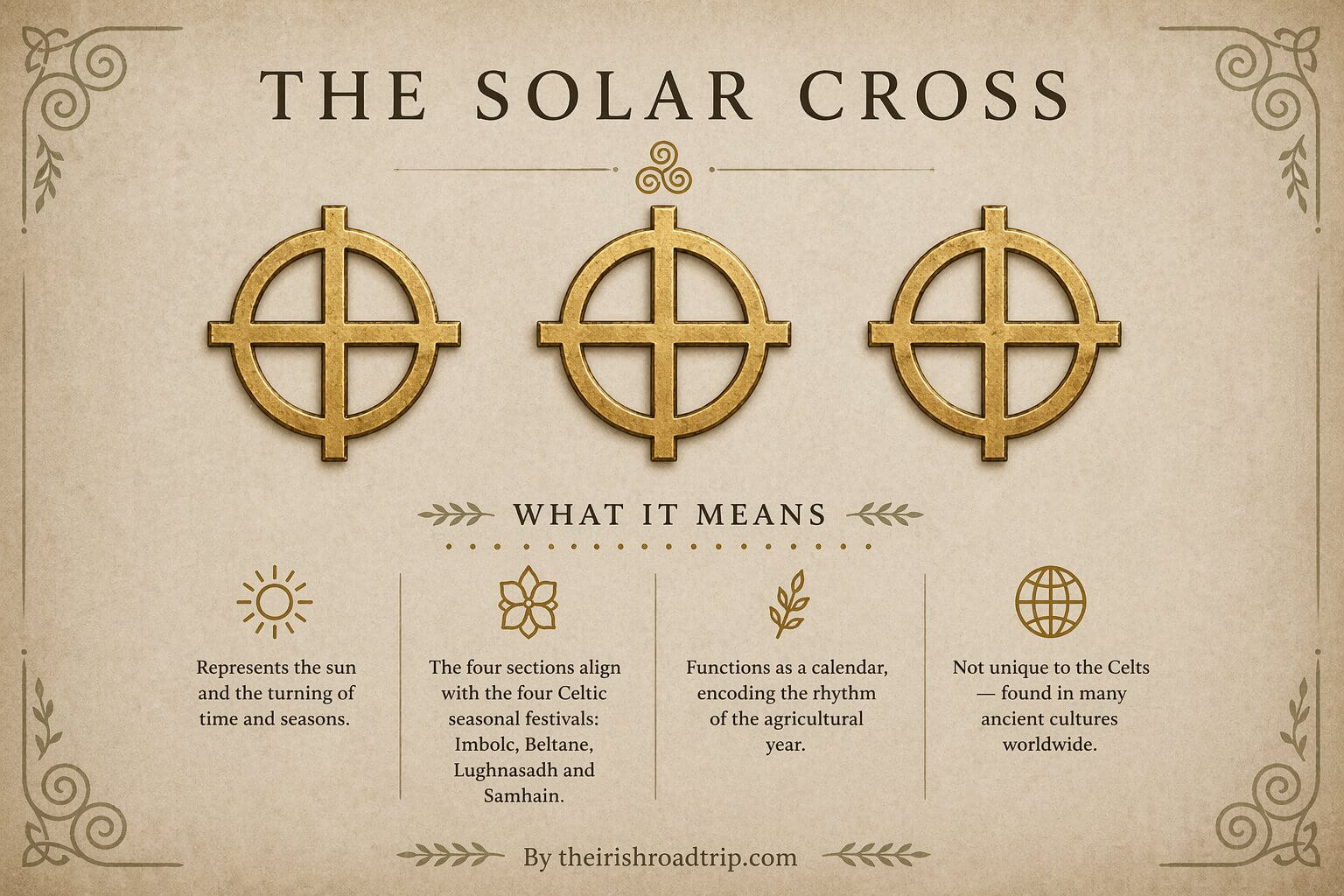
The Solar Cross is one of those symbols that appears in almost every ancient culture simultaneously, which should tell you something about how fundamental the sun was to early human life.
Among the Celts it carried particular weight, representing the wheel of the year and the turning of the seasons
The four sections of the cross align with the four great Celtic seasonal festivals: Imbolc, Beltane, Lughnasadh and Samhain.
In that sense, the Solar Cross functions almost as a calendar, encoding the rhythm of the agricultural year into a single image.
The Green Man
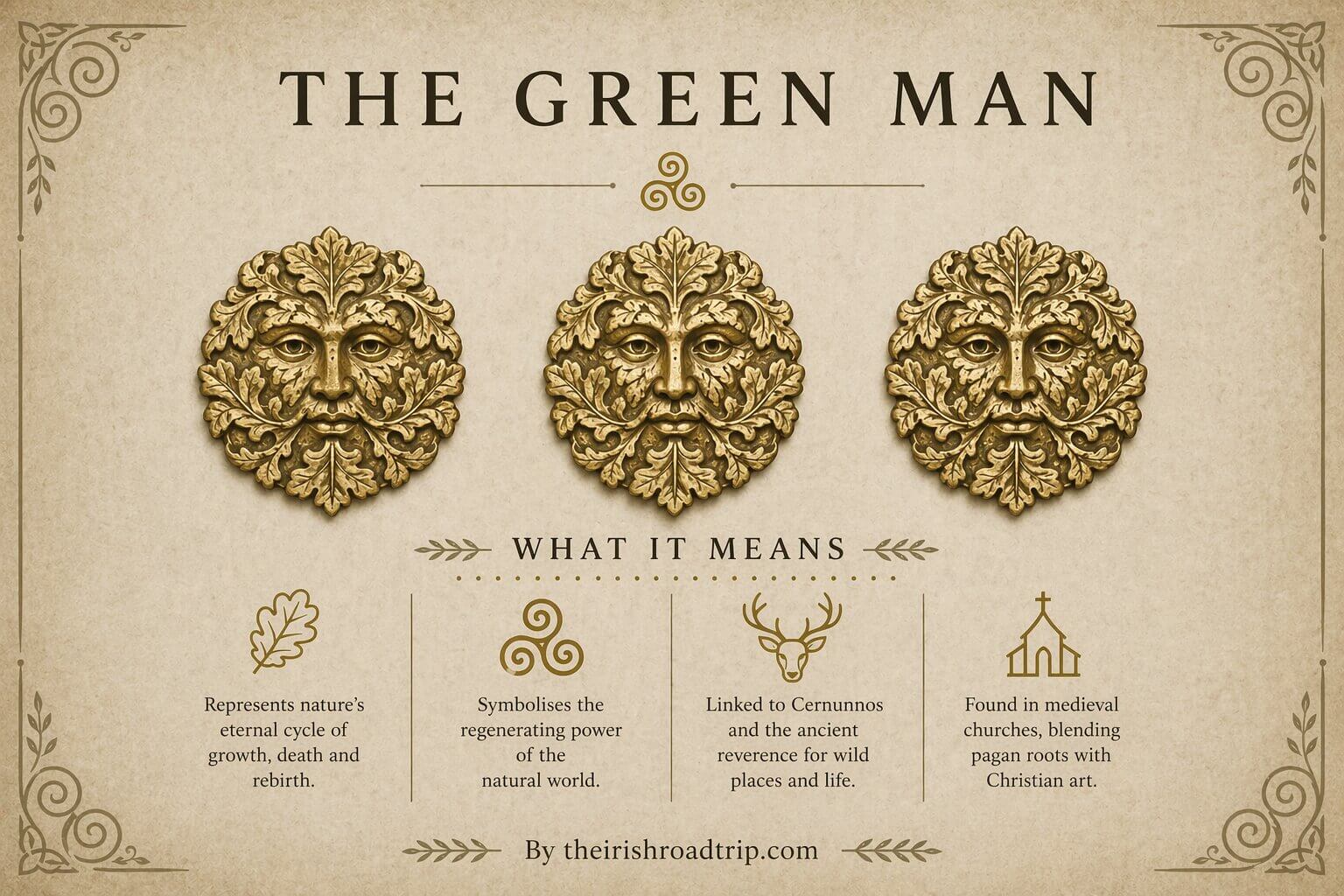
The Green Man is one of the most visually striking Celtic designs – a face made entirely of leaves, or wreathed so deeply in foliage that the two become inseparable.
You’ll find him carved into medieval churches across Britain and Ireland, peering out from stone corbels and column capitals with an expression that’s hard to read.
His presence in Christian churches is curious, given that his origins are clearly rooted in older nature worship.
He represents the power of the natural world to regenerate – the return of spring after winter, the persistence of life even through decay.
Cernunnos
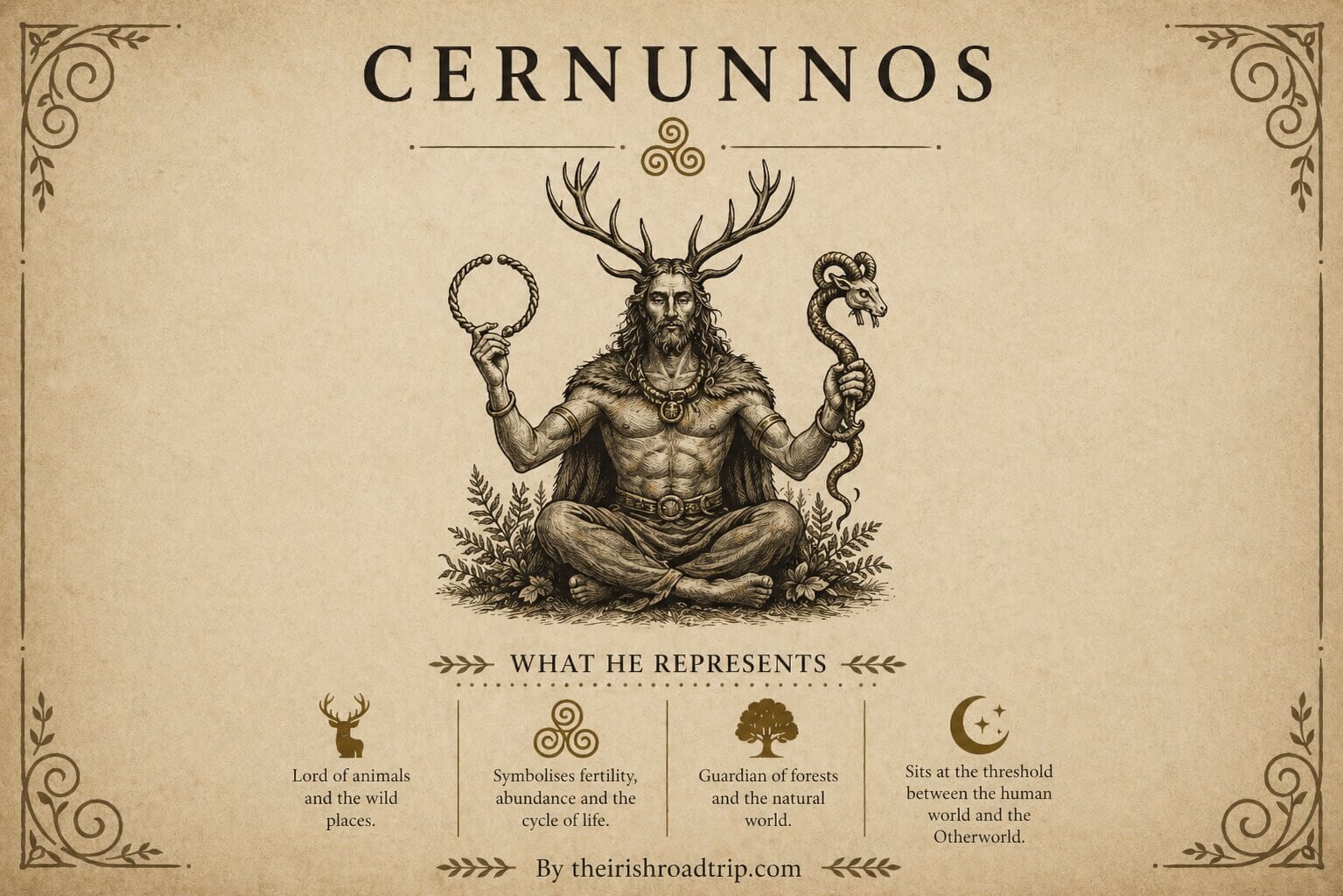
Cernunnos is the antlered god of the Celts – a deity associated with wild animals, forests, fertility and the Otherworld.
He is most famously depicted on the Gundestrup Cauldron, a remarkable silver ritual vessel discovered in Denmark and dated to around the 1st century BC.
What makes Cernunnos particularly interesting as one of the Celtic symbol is how little we actually know about him. His name appears only once in a surviving inscription, and most of what we understand about him comes from iconography rather than text.
He was clearly significant – he appears across Celtic Europe – but the Celts left us frustratingly few written records. As a symbol, Cernunnos represents the wild and untamed aspects of life.
The Celtic Labyrinth
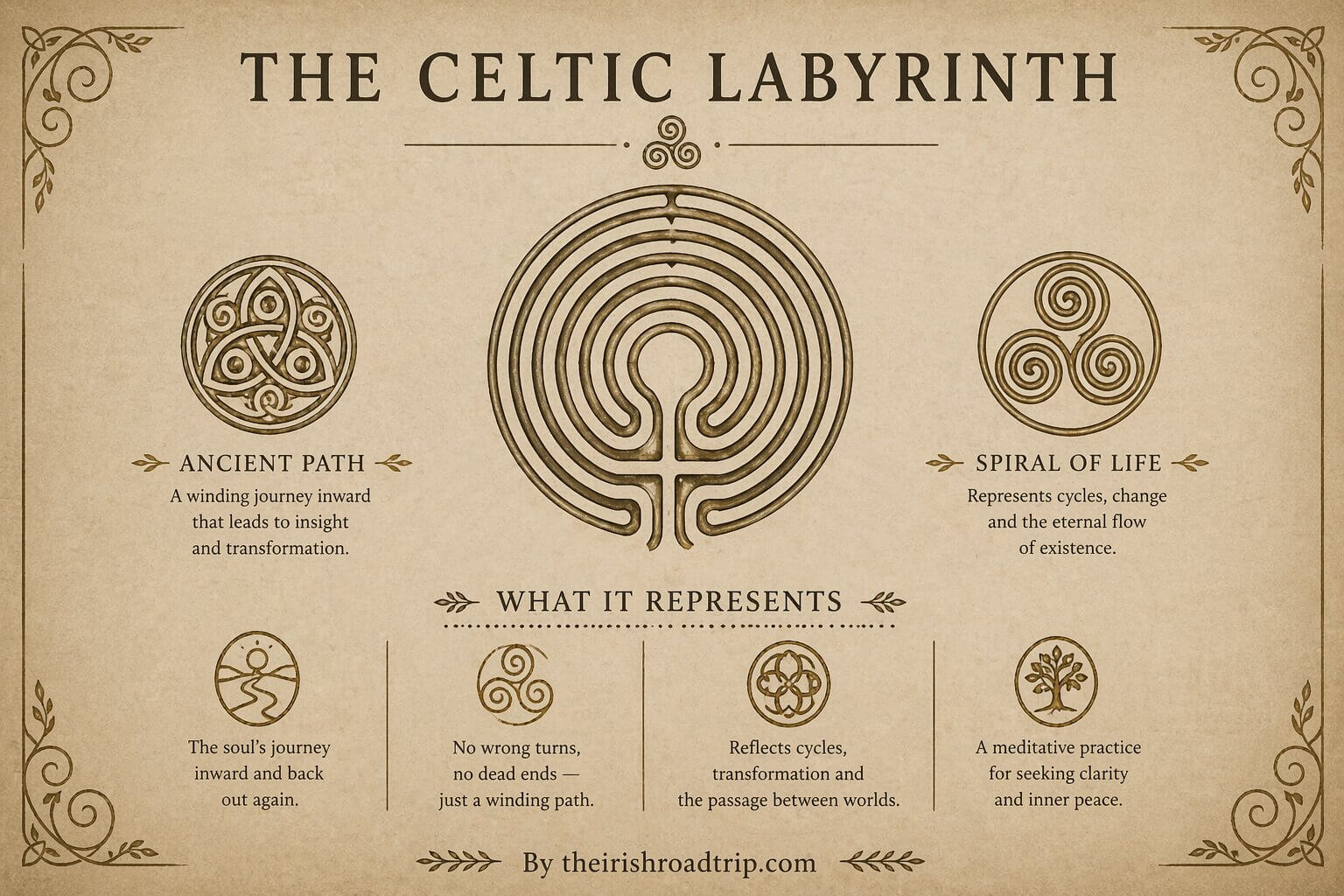
The labyrinth is one of humanity’s oldest symbols, appearing in ancient Greece, Crete, India and across prehistoric Europe.
The Celtic version incorporates the familiar interlacing knotwork and spiral forms, and uses the labyrinth as a metaphor for the soul’s path – a single winding route leading inward to a centre and back out again.
Unlike a maze, a labyrinth has no wrong turns and no dead ends. The journey is the point. In Celtic tradition, this maps neatly onto ideas about cycles, transformation and the passage between worlds.
Walking a labyrinth, physically or symbolically, became a meditative practice, a way of processing change or seeking clarity.
The Five-Fold Symbol
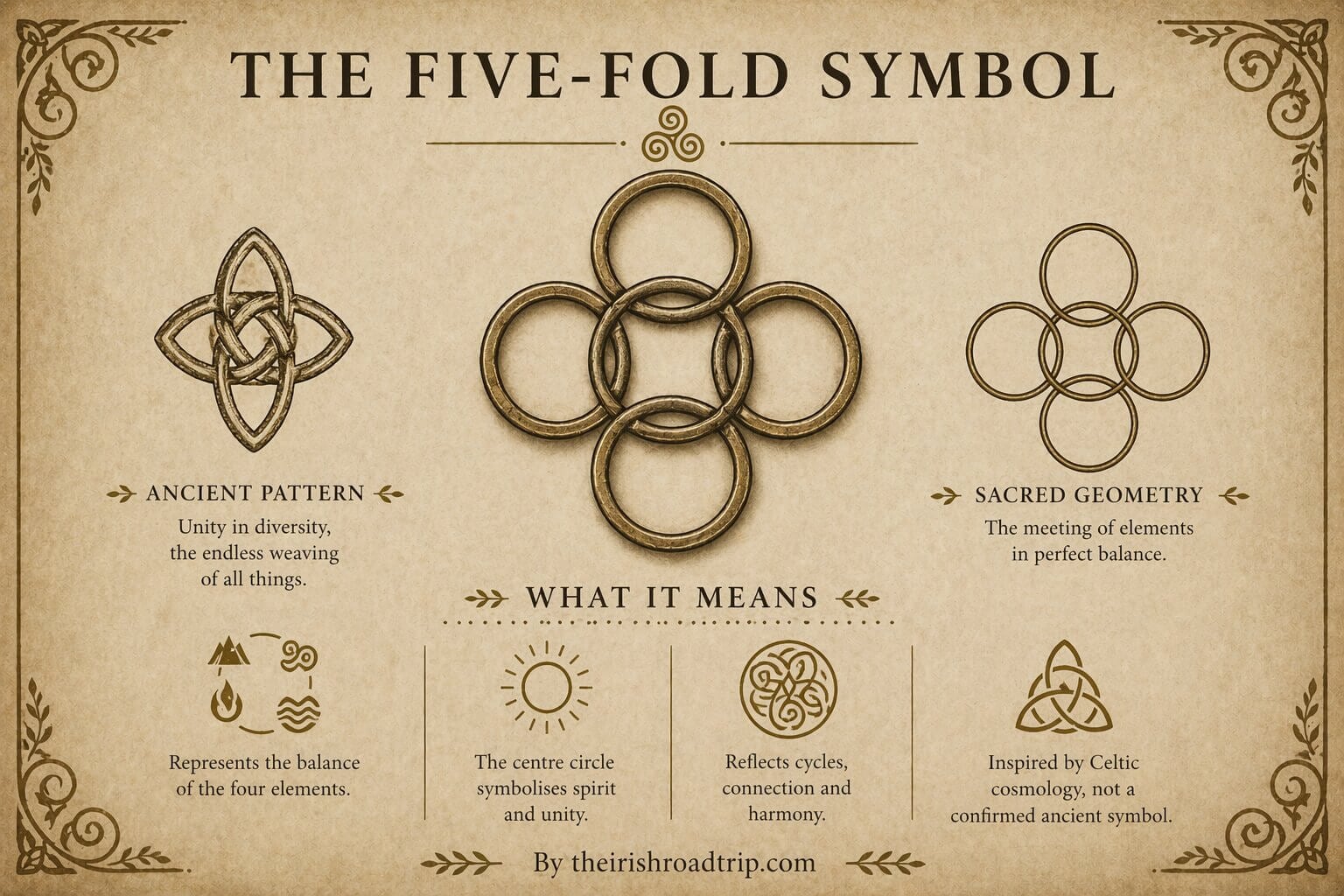
The Five-Fold Symbol represents the balance between the classical elements: earth, air, fire and water, with the fifth central point representing spirit or divine unity.
It’s a satisfying piece of geometry that speaks to a very Celtic preoccupation with balance and the interconnectedness of all things.
The honest caveat here is that while the concept is consistent with Celtic cosmology, the specific symbol as a named Celtic design has limited direct archaeological evidence behind it.
It’s widely used in modern Celtic and Pagan spiritual traditions, and its underlying ideas are genuinely rooted in Celtic thinking, but treat it as a symbol inspired by Celtic belief only.
Celtic knots and their meanings
At a glance, Celtic knots look intricate, but their meaning is rooted in something simple – a single, unbroken line.
This is where Celtic knot meaning comes from, with each pattern reflecting continuity, connection and the cycles of life.
The Celtic Tree of Life
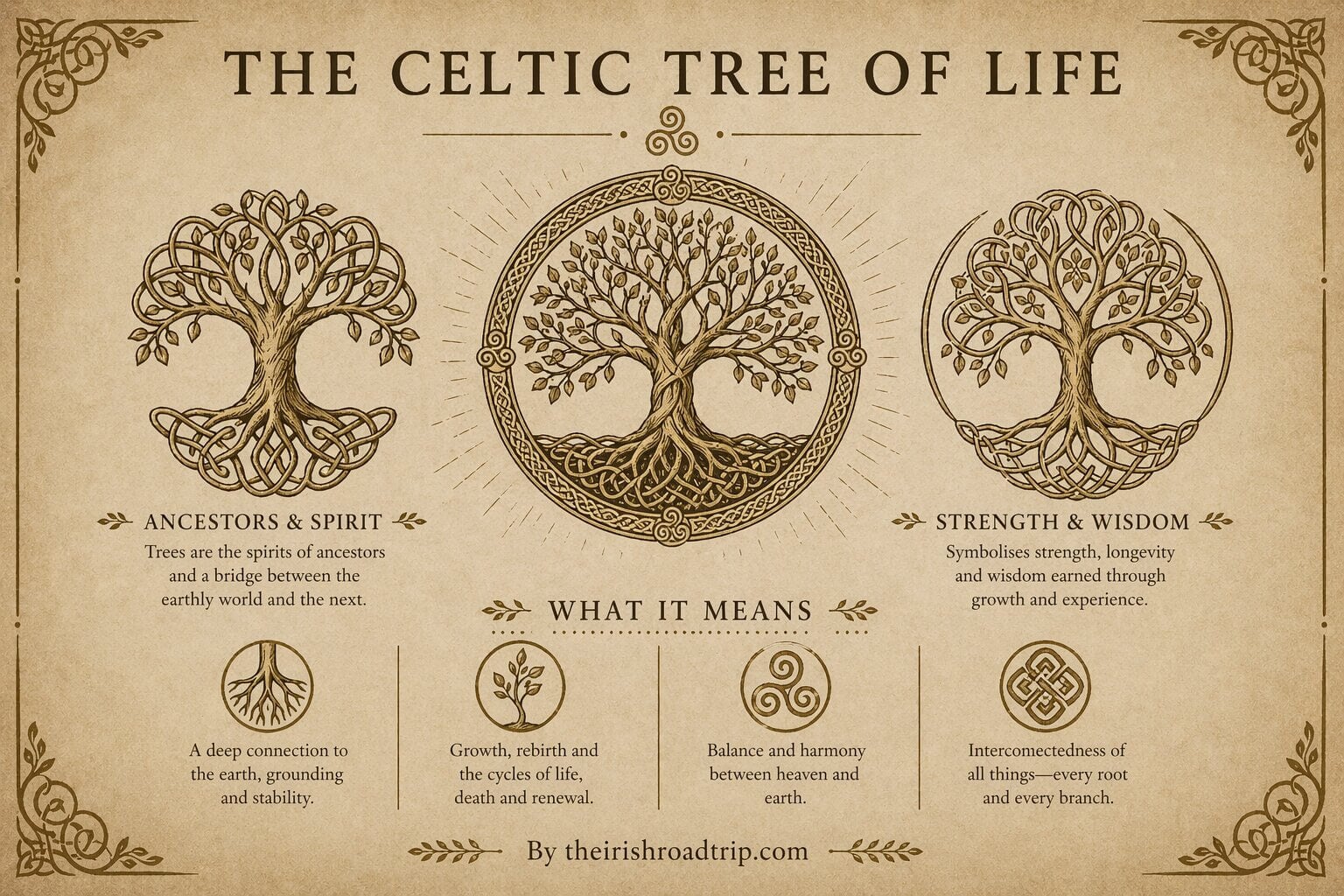
The intricately interwoven branches and roots of the Celtic Tree of Life form a strong and earthy Celtic symbol for strength that’s often associated with the Druids.
While the branches reach for the sky, the roots permeate the earth. For the ancient Celts, the Tree of Life symbolises balance and harmony and the close association between heaven and earth.
The Celts believed that trees were the spirits of their ancestors and that they provided a link between their earthly life and the next.
This Celtic symbol meaning is clear – it represents strength, longevity and wisdom, each of which are attributes that the Celts revered.
They also believed that the tree symbolised rebirth (they would have witnessed oak trees, in particular, shed their leaves in fall and grow new ones in spring).
The symbol, which was heavily featured in Insular Art, also clearly shows the link between every root below the ground and every branch above.
The Triquetra / Trinity Knot
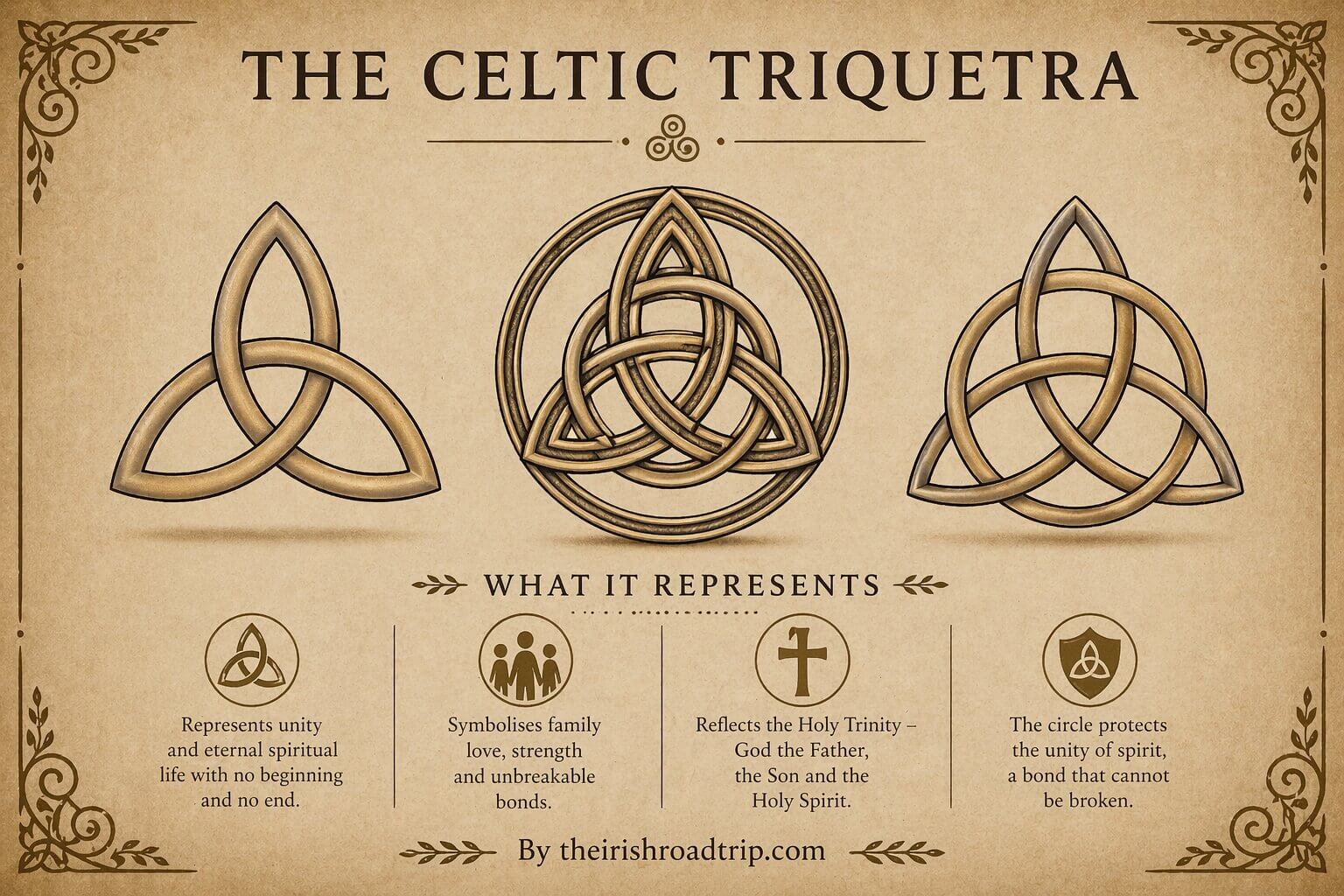
While there is no definitive Celtic symbol for family, there are several ancient Celtic knots that represent the meanings of eternal love, strength and family unity.
The Triquetra, also known as the Trinity Knot and the Celtic Triangle, appears in early medieval art, most notably in the Book of Kells, and in Norwegian stave churches from the 11th century.
This Celtic Knot meaning is that, with no beginning and no end, it represents unity and eternal spiritual life. The symbols line interweaves through the circle in an unbroken flow.
This symbol represents the pillars of early Celtic Christian teachings of the Holy Trinity (God the Father, the Son and the Holy Spirit).
It also represents the unity of spirit when enclosed in a circle. The circle protects it, so the symbolic spirit cannot be broken.
The Dara Knot
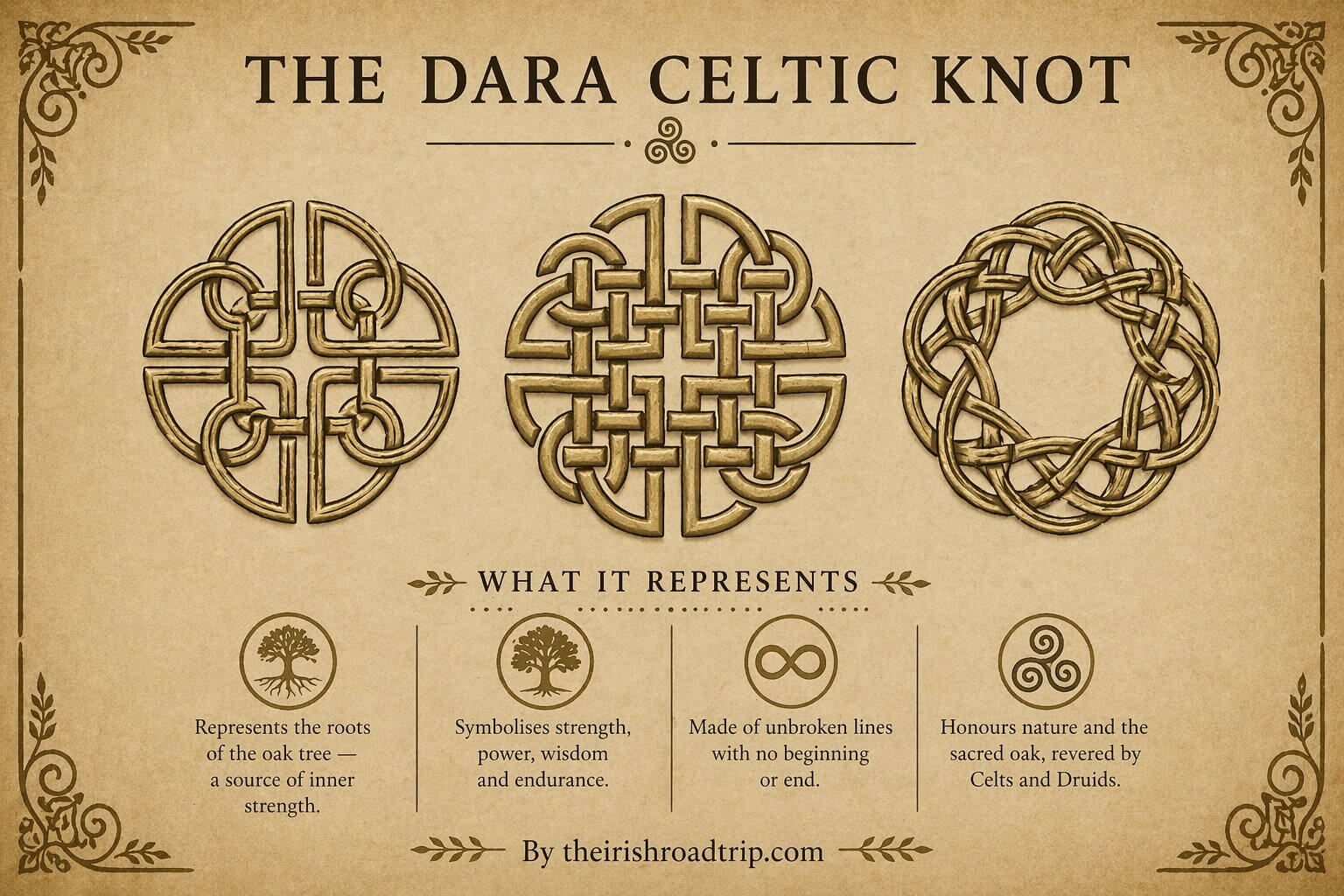
Another of the better-known Irish Celtic symbols is the Dara Knot. This symbol boasts an interwoven design and a name that comes from the Irish word ‘Doire’ which means “oak tree”.
Like many Celtic knot symbols, the Dara Knot is made up of intertwined lines with no beginning or end.
There is no single design for the Dara Knot but all versions are centred on the common theme of the oak tree and its roots.
Celts and Druids revered nature, particularly ancient oak trees, and considered them sacred. They saw the oak tree as a symbol of strength, power, wisdom, and endurance.
Serch Bythol
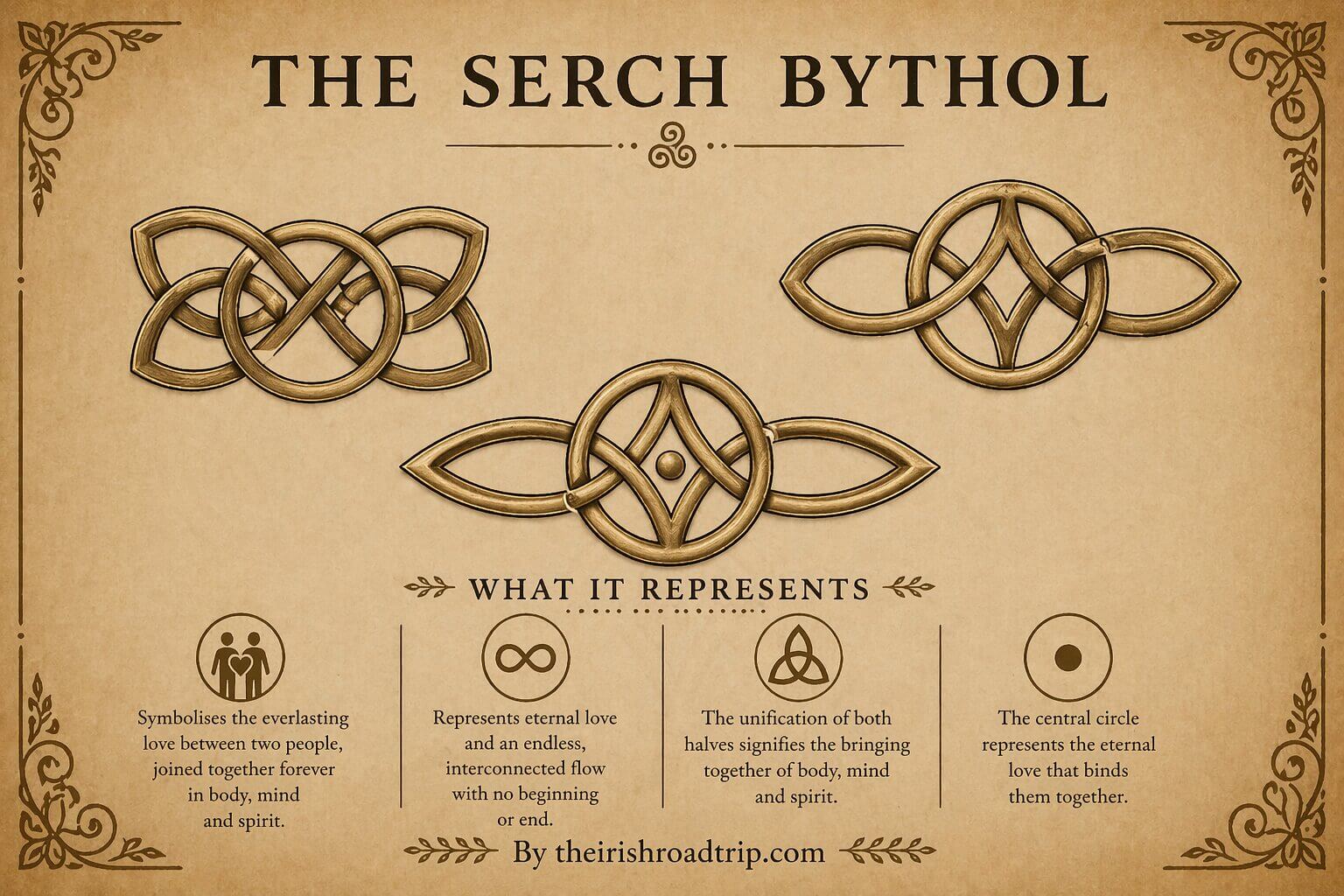
Although less well known than some other ancient Celtic symbols, the Serch Bythol is significant.
The Serch Bythol symbol is made from two Celtic knots / triskeles to symbolize the everlasting love between two people, which is why it’s one of the more popular Celtic friendship symbols.
The two defined yet closely intertwined parts represent two people joined together forever in body, mind, and spirit.
This symbol is believed to represent eternal love and the side-by-side design creates an endless interconnected flow of lines without end.
You’ll often see some of the Celtic mythology creatures with versions of this Celtic artwork on their armour.
The Celtic Motherhood Knot
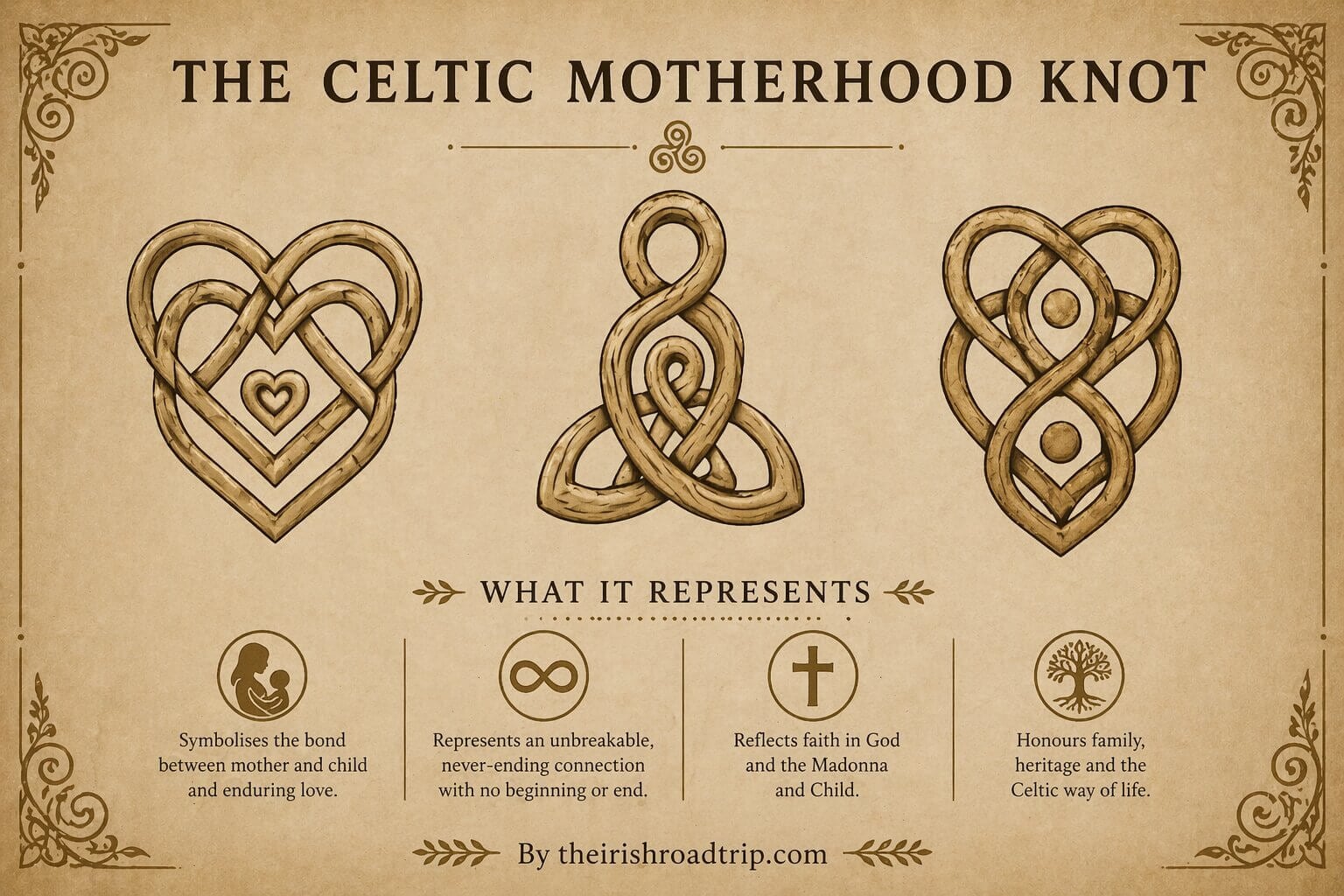
Celtic knots, called Icovellavna, include many knots used for decoration in the Celtic style of Insular Art.
The elaborate Celtic Motherhood Knot symbolizes the bond between mother and child or, in Christianity, the Madonna and Child.
The meaning of the Celtic Motherhood Knot is one of enduring love between a mother and child, faith in God and the Celtic heritage.
Do note that while many design variations represent specific family relationships, several are modern inventions, such as:
- The Celtic symbol for mother and son
- The Celtic mother daughter knot
- The Celtic symbol for sisterhood
- The Celtic symbol for brothers
Solomon’s Knot
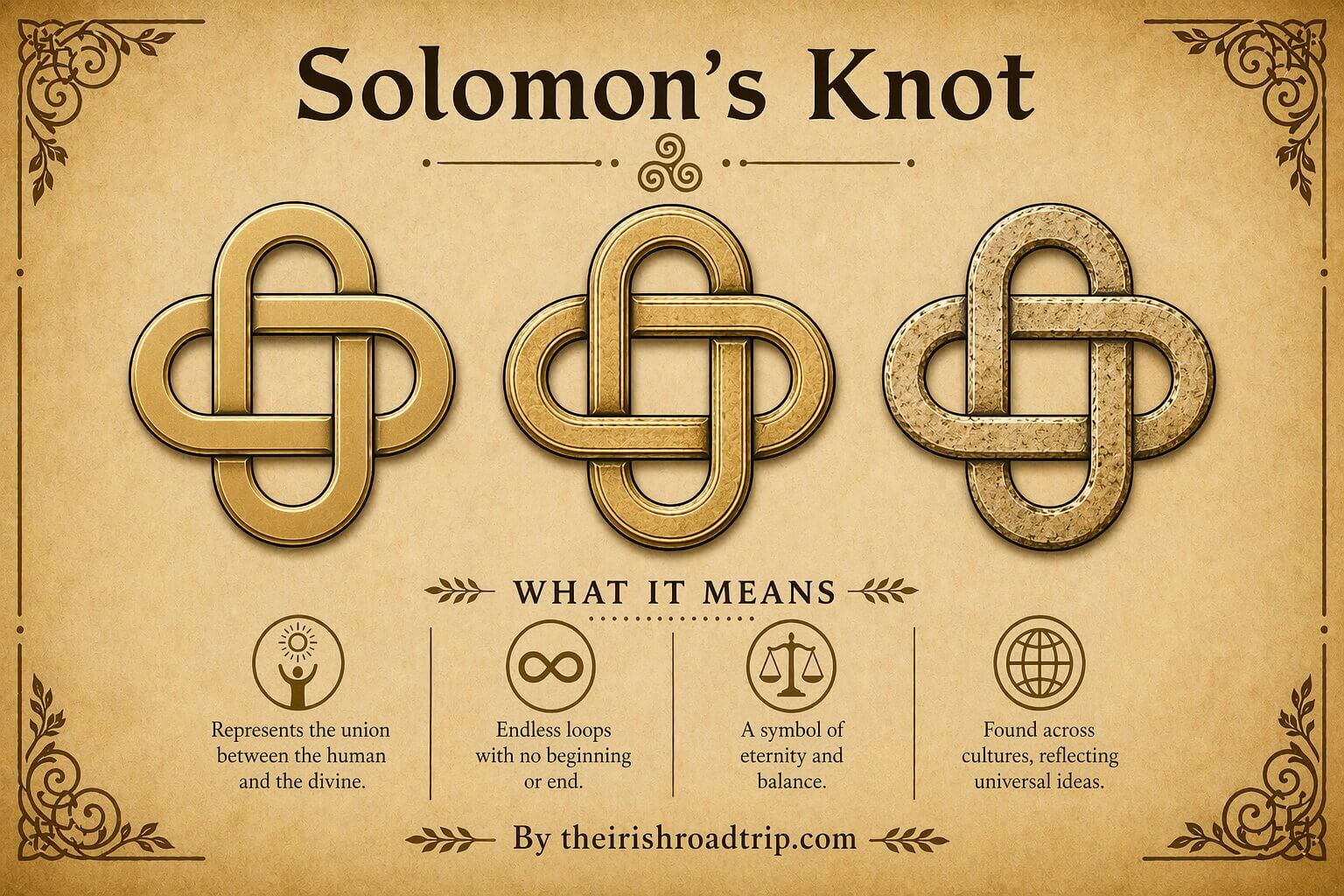
Solomon’s Knot is one of the oldest decorative motifs in human history, appearing in Roman floor mosaics, medieval church art and Celtic knotwork traditions alike.
Unlike most Celtic symbols, it is made from two interlocking loops rather than a single continuous line, which gives it a distinct visual identity.
In Celtic tradition it represents the union between the human and the divine – a bridge between the earthly and the spiritual.
Its presence in so many different cultures simultaneously is a reminder that some ideas are so fundamental they arise independently wherever humans start making art and asking big questions.
The Celtic Love Knot
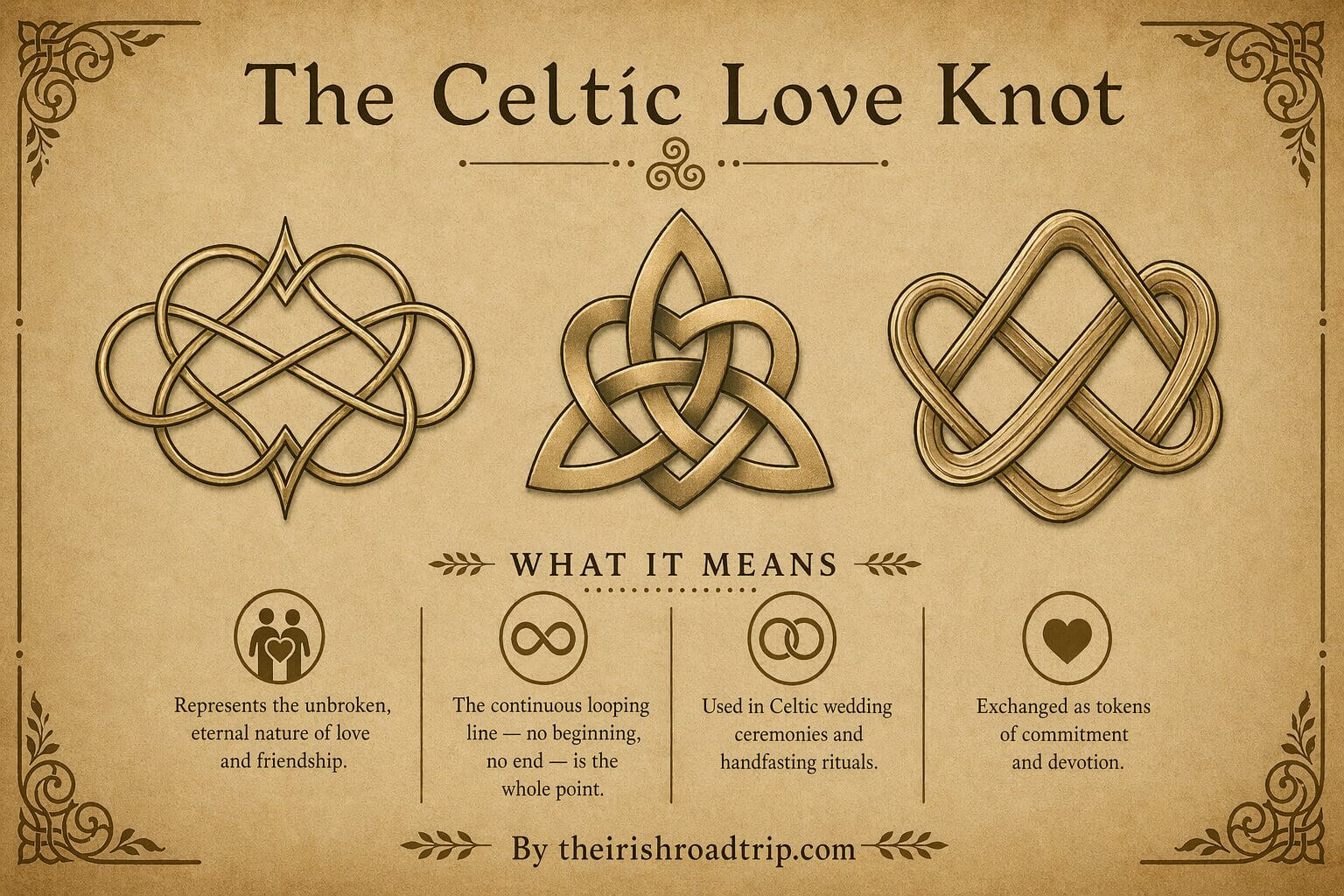
The Celtic Love Knot is less a single defined symbol and more a family of knotwork designs united by a common theme: the unbroken, eternal nature of love and friendship.
The continuous looping line, with no beginning and no end, is the whole point. It says this connection does not stop.
Love knots appear in Celtic wedding ceremonies and handfasting rituals, and were exchanged as tokens of commitment and devotion.
The specific designs vary, but the underlying language is consistent: two lives woven together in a pattern that cannot be undone.
The Quaternary Knot
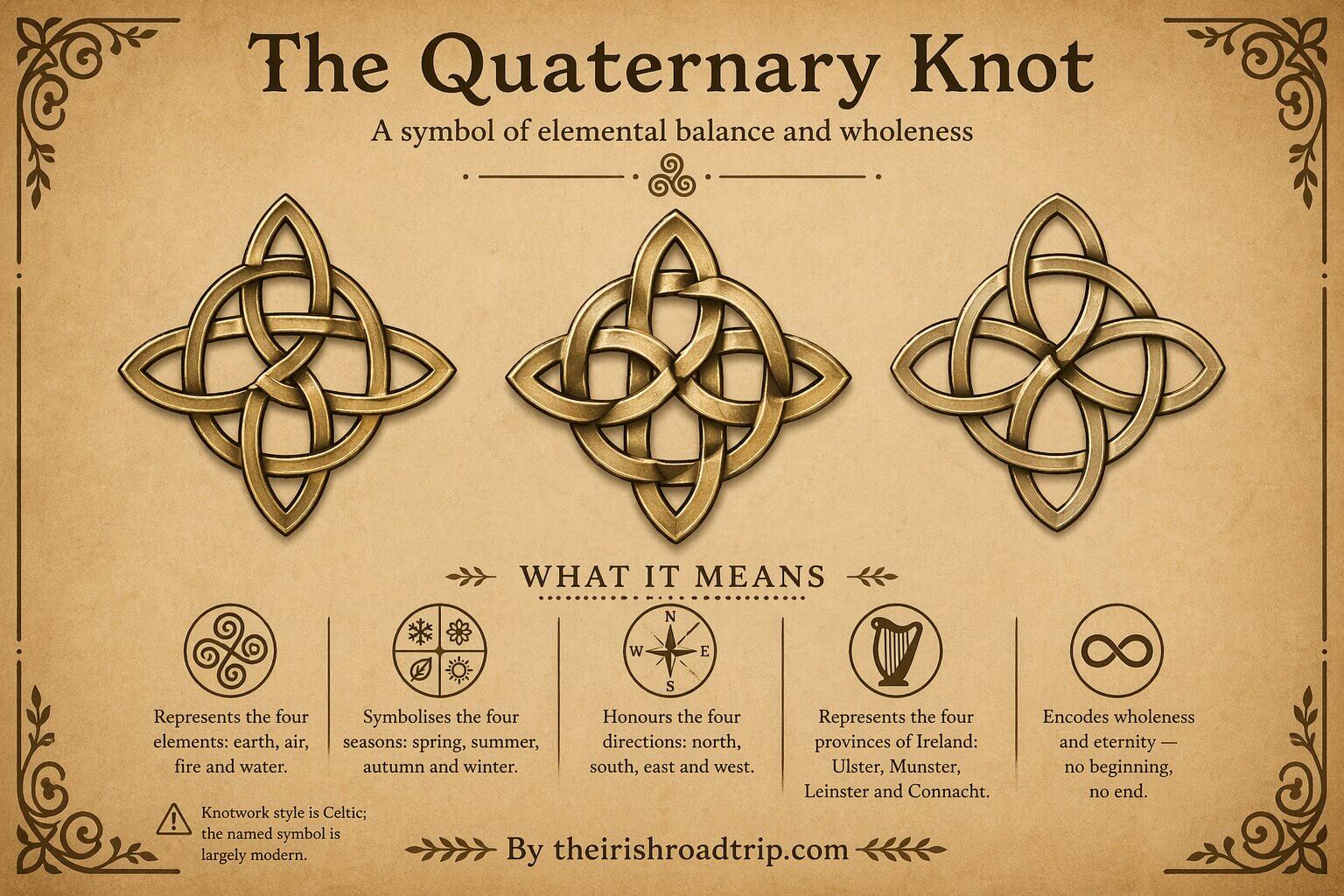
The Quaternary Knot is a symbol of elemental balance and wholeness. While the knotwork style is Celtic, the named symbol is largely modern.
Where the Triquetra works in threes, the Quaternary Knot works in fours – four interlocking loops representing the four elements, the four seasons, the four cardinal directions, or the four provinces of Ireland: Ulster, Munster, Leinster and Connacht.
The Quaternary Knot encodes that completeness in a design that, like all Celtic knots, has no beginning or end, suggesting that the wholeness it represents is eternal, not temporary.
The Sailor’s Knot
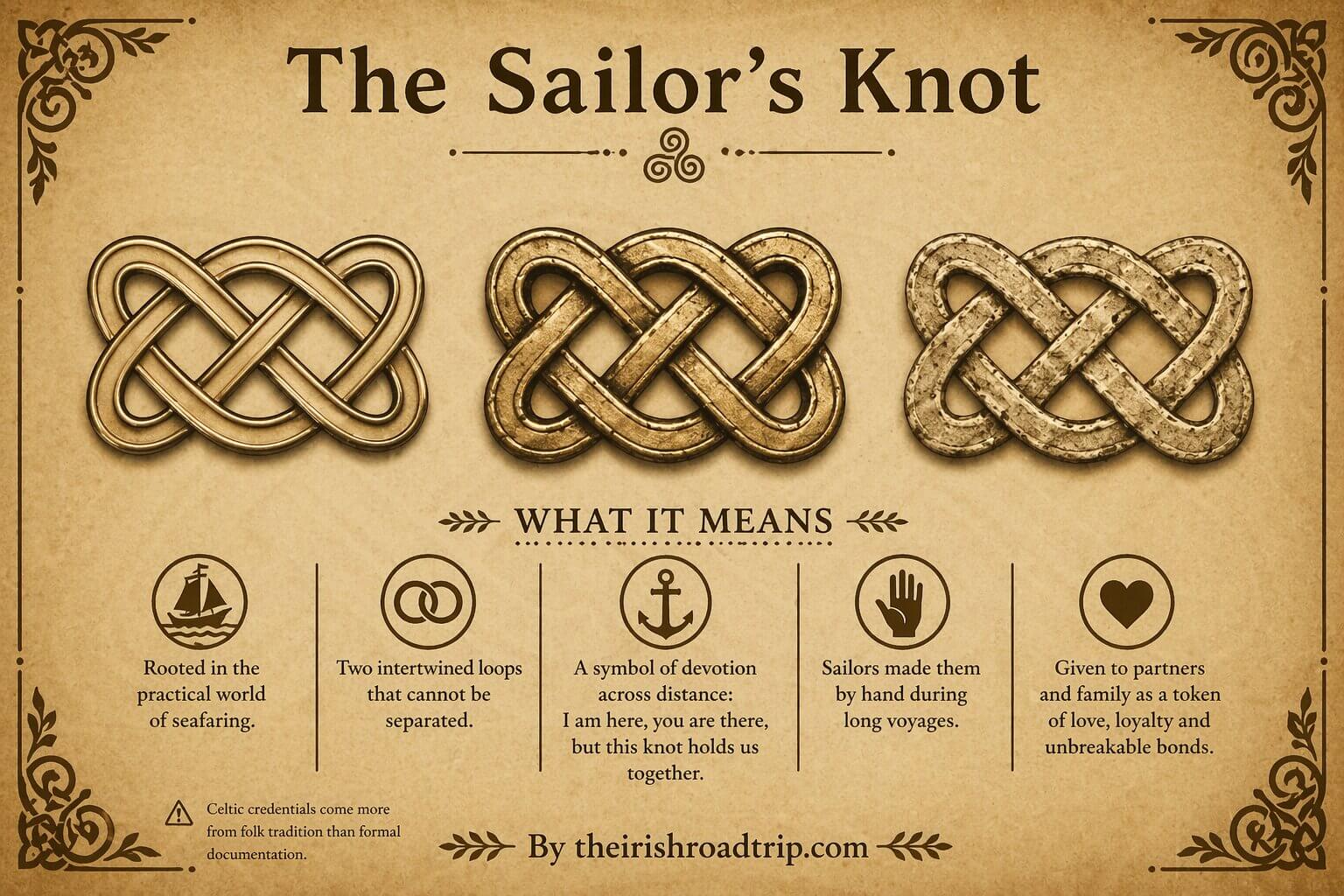
The Sailor’s Knot is rooted in the practical world of seafaring, and its symbolism follows directly from that world.
Celtic sailors, like sailors everywhere, spent long stretches away from home, and the knots they tied became tokens of the bonds they were maintaining across distance.
The design features two intertwined loops that cannot be separated, which made it a natural emblem of devotion: I am here, you are there, but this knot holds us together.
Sailors made them by hand during long voyages and gave them to partners and family members on returning home.
Irish symbols often mistaken as Celtic
Many Irish symbols are often incorrectly included in guides to Celtic symbols and meanings, when they’re actually Irish in origin or much more recent.
Below are some of the most commonly misattributed designs and where they really come from.
Ogham

Photos via Shutterstock
Ogham is a collection of Gaelic symbols that formed an alphabet. It was an early Irish writing system that was used by the Celts in Ireland and parts of Britain.
Carved into stone pillars, it often marked graves or boundaries, with each letter symbolically tied to a tree or plant.
Unlike the more expansive traditions of the European Celts, this script remained distinctly rooted in Gaelic culture.
The Irish Harp
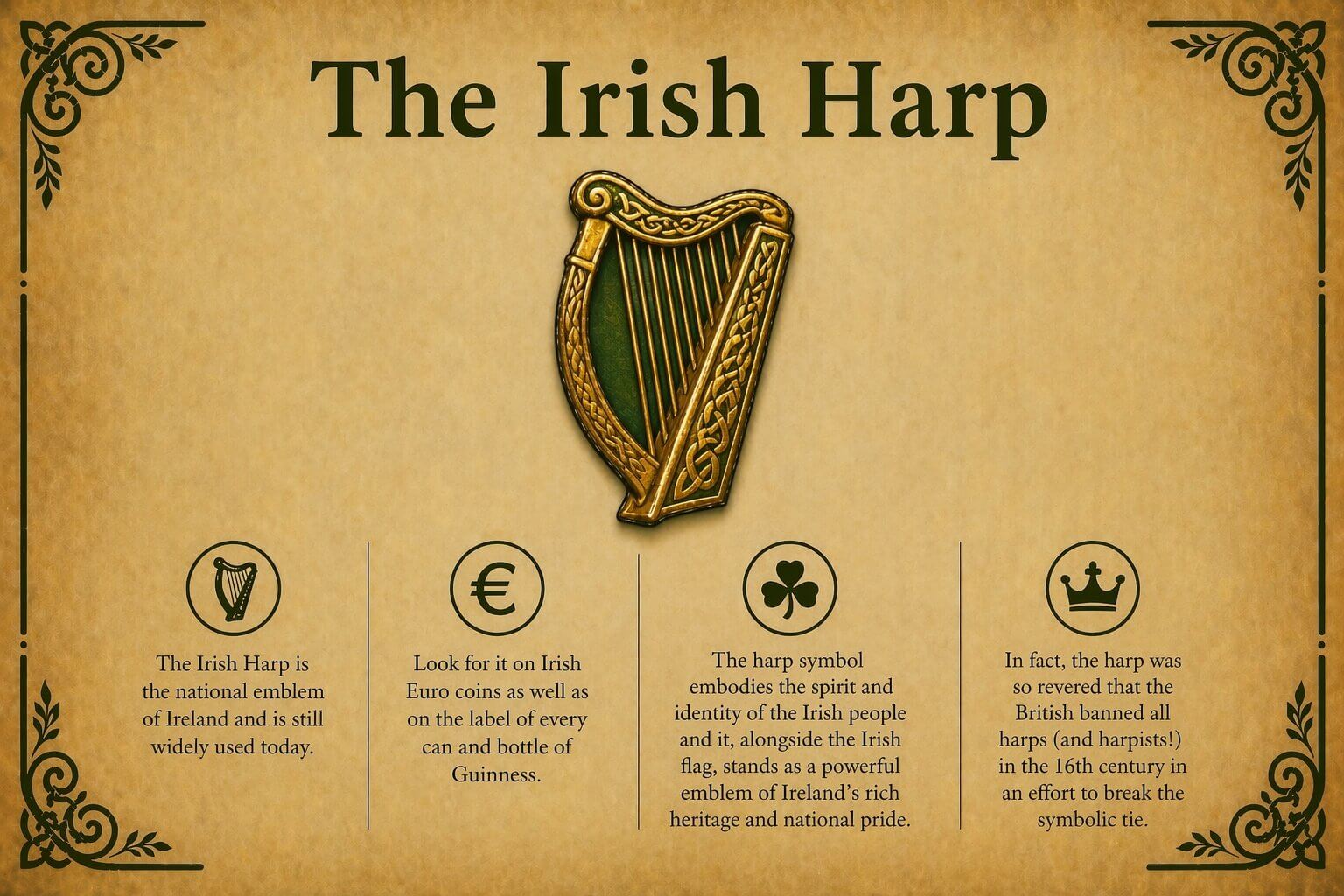
The second of the modern Celtic signs in this guide is the Harp. The Irish Harp is the national emblem of Ireland and is still widely used today.
Look for it on Irish Euro coins as well as on the label of every can and bottle of Guinness.
The harp symbol embodies the spirit and identity of the Irish people and it, alongside the Irish flag, stands as a powerful emblem of Ireland’s rich heritage and national pride
In fact, the harp was so revered that the British banned all harps (and harpists!) in the 16th century in an effort to break the symbolic tie.
The Shamrock
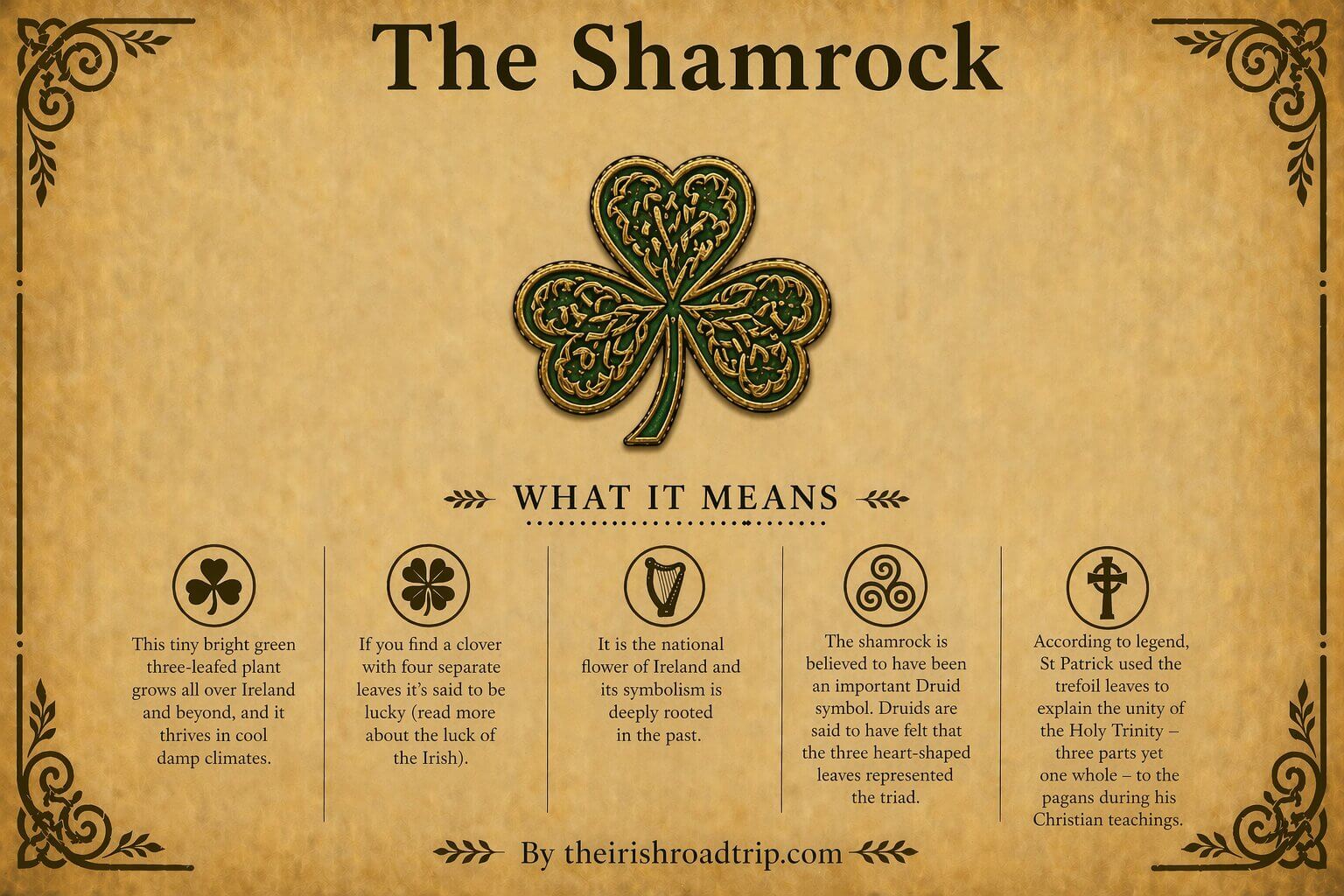
The Shamrock is another of the many Irish symbols that tends to be mistaken for one of the ancient Celtic symbols.
This tiny bright green three-leafed plant grows all over Ireland and beyond, and it thrives in cool damp climates.
If you find a clover with four separate leaves it’s said to be lucky (read more about the luck of the Irish). It is the national flower of Ireland and its symbolism is deeply rooted in the past.
The shamrock is believed to have been an important Druid symbol. Druids are said to have felt that the three heart-shaped leaves represented the triad.
According to legend, St Patrick used the trefoil leaves to explain the unity of the Holy Trinity – three parts yet one whole – to the pagans during his Christian teachings.
The Claddagh ring
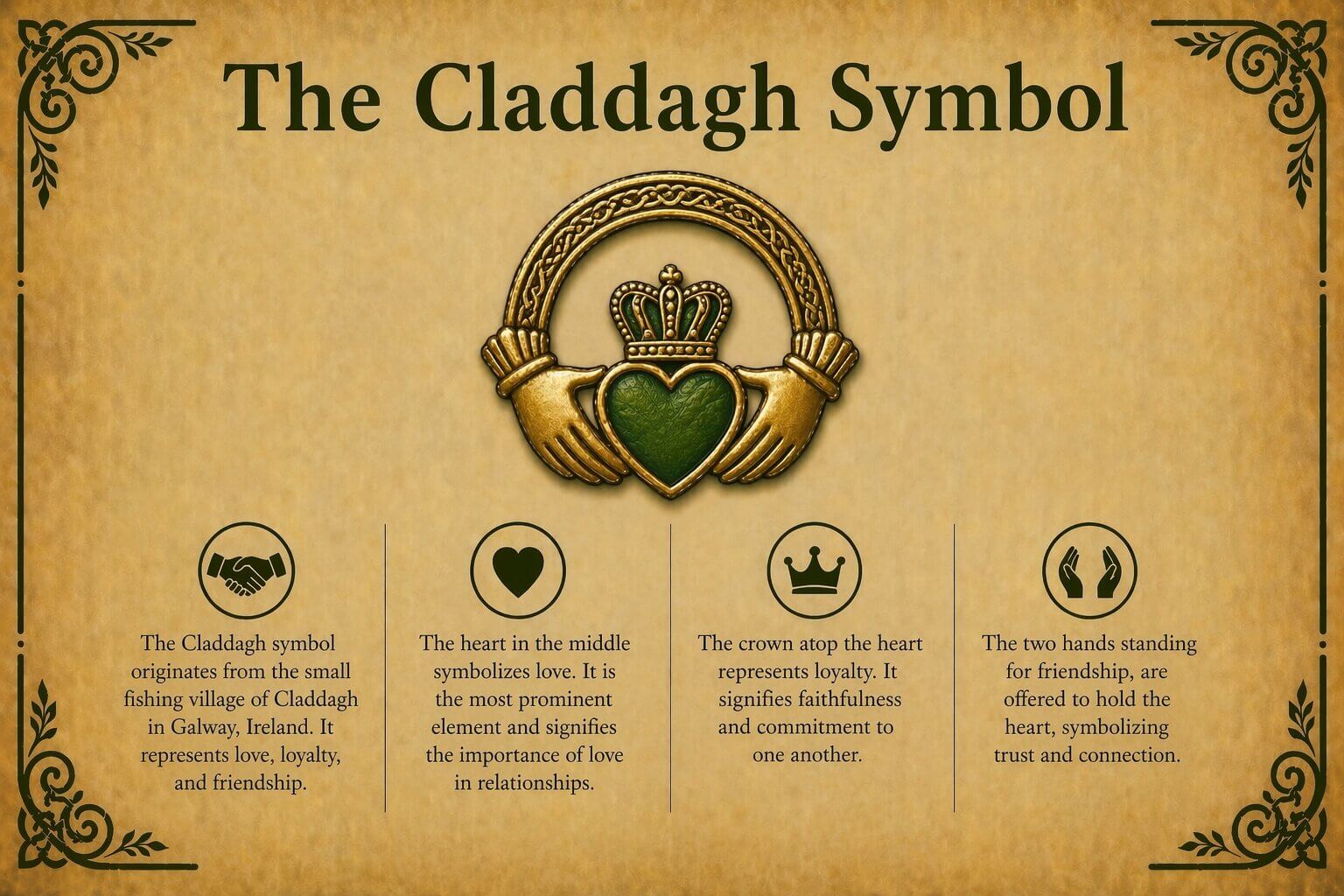
When it comes to Celtic symbols for love, one design tends to incorrectly pop up time and time again, despite clear evidence of its origin.
I’m talking, of course, about the Claddagh. Now, don’t get me wrong, the Claddagh is a beautiful Irish symbol, but it has nothing to do with the Celts.
The Claddagh symbol originated in County Galway in a little fishing village of the very same name.
Claddagh rings are widely exchanged in Ireland and elsewhere as a symbol of loyalty and unity. The word Claddagh is the name of the coastal village where the design was invented by Richard Joyce.
St. Brigid’s Cross
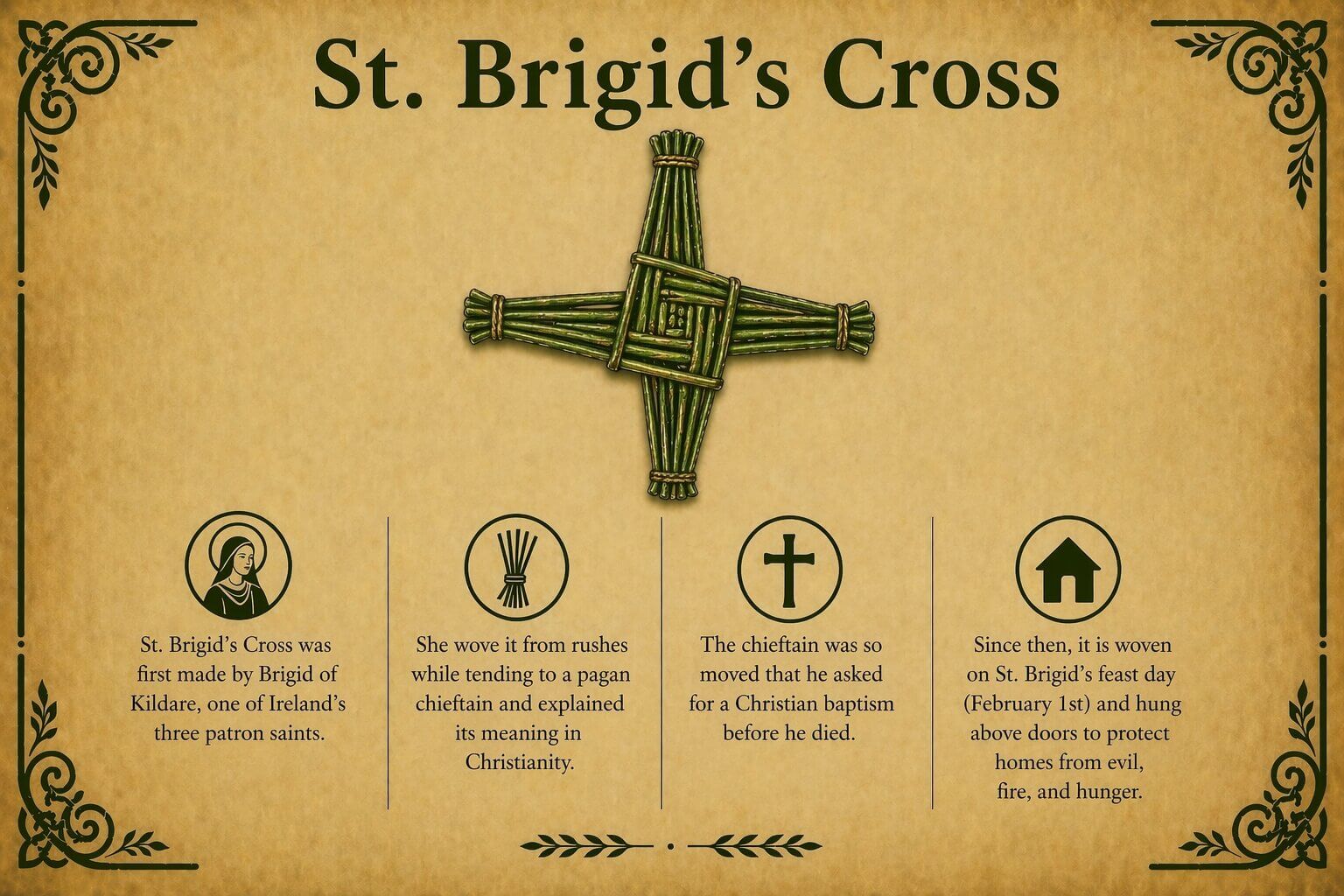
Many guides to Irish symbols overlook St. Brigid’s Cross, despite how deeply rooted it is in Irish tradition. The cross is linked to Brigid of Kildare, one of Ireland’s patron saints.
According to legend, she was tending to a dying pagan chieftain when she picked up rushes from the floor and began weaving a cross as she explained the Christian faith.
By the time she finished, the chieftain had converted and requested baptism. Since then, it’s been a tradition to weave St. Brigid’s Cross from rushes or straw on the eve of her feast day, February 1st.
Celtic animal symbols
Animals played a central role in Celtic belief, often appearing in mythology as messengers, guides or symbols of power.
Rather than fixed meanings, these creatures were tied to stories, traits and the natural world the Celts lived in.
The Raven
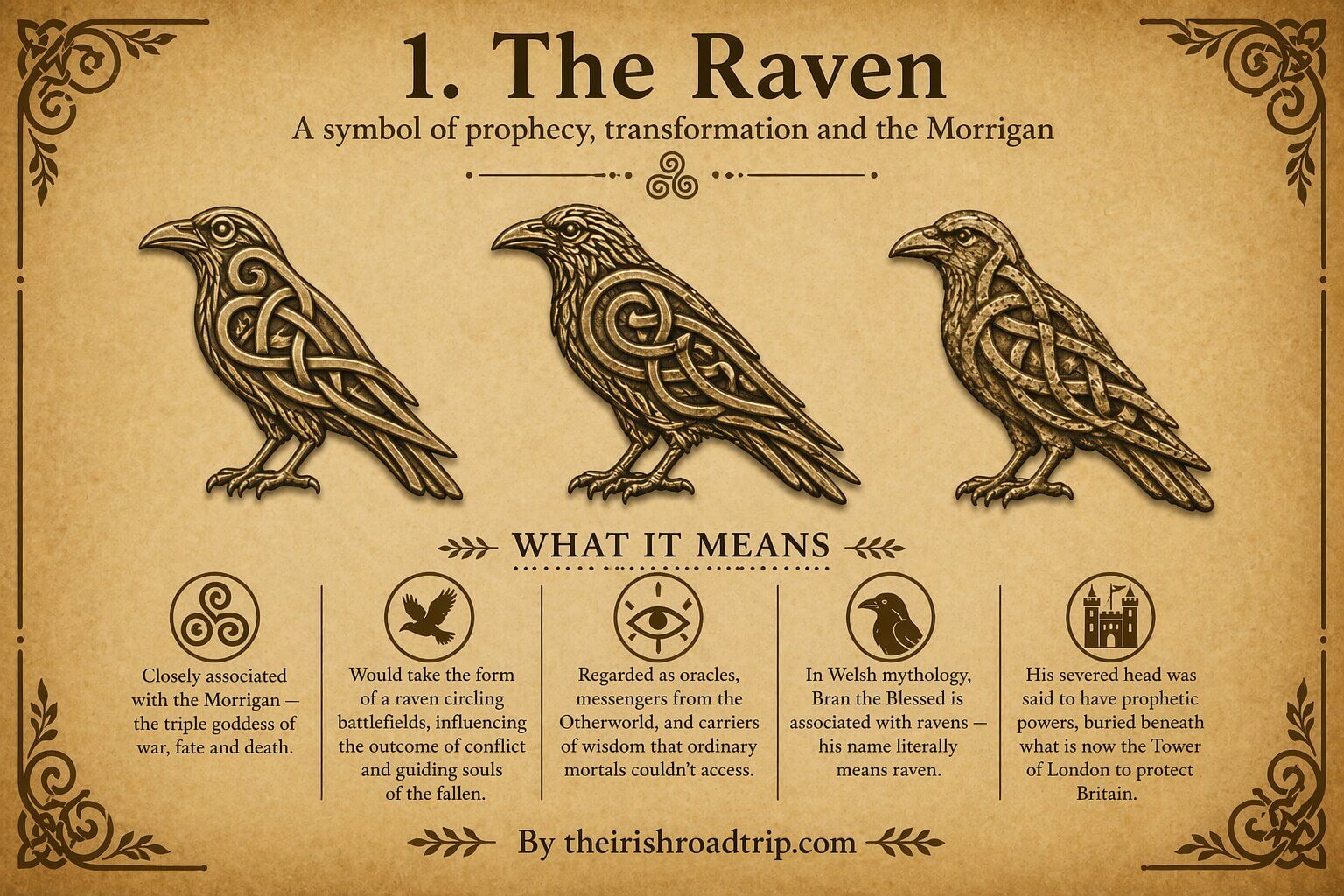
The Raven is one of the most powerful and unsettling presences in Celtic mythology. It is closely associated with the Morrigan – the triple goddess of war, fate and destiny – who would take the form of a raven circling battlefields, influencing the outcome of conflict and guiding souls of the fallen.
Ravens were not simply birds of ill omen, though. They were also regarded as oracles, messengers from the Otherworld, and carriers of wisdom that ordinary mortals couldn’t access.
In Welsh mythology, Bran the Blessed is associated with ravens – his name literally means raven – and his severed head was said to have prophetic powers, buried beneath what is now the Tower of London to protect Britain.
The Stag
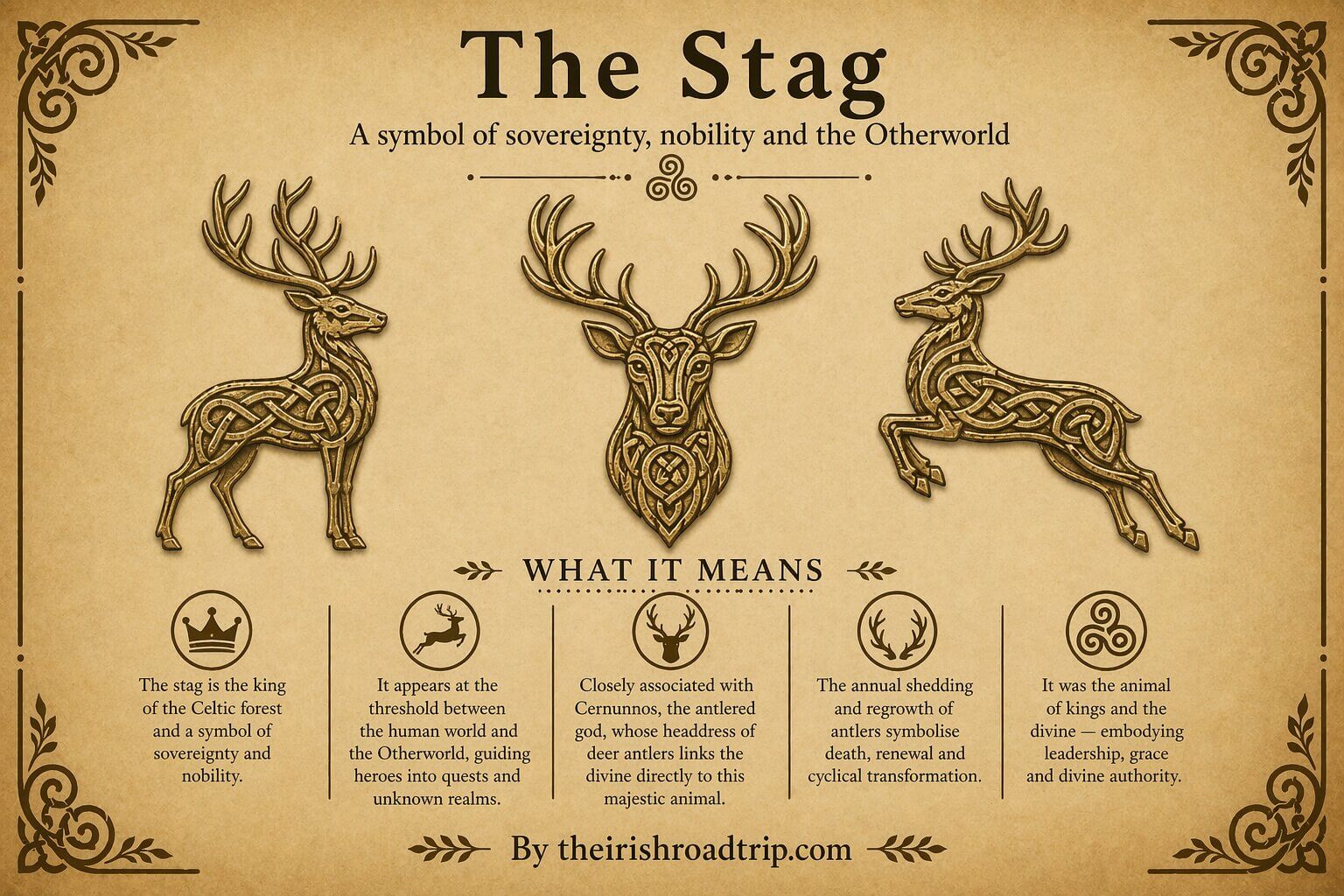
The Stag is the king of the Celtic forest, and in Celtic mythology it frequently appears at the threshold between the human world and the Otherworld.
Heroes encounter stags at the beginning of quests, chasing a white stag into unknown territory before finding themselves in places that operate by different rules entirely.
The stag is also inseparable from Cernunnos, the antlered god, whose headdress of deer antlers links the divine directly to this animal.
The annual shedding and regrowth of antlers reinforced Celtic beliefs in death, renewal and cyclical transformation.
The Salmon
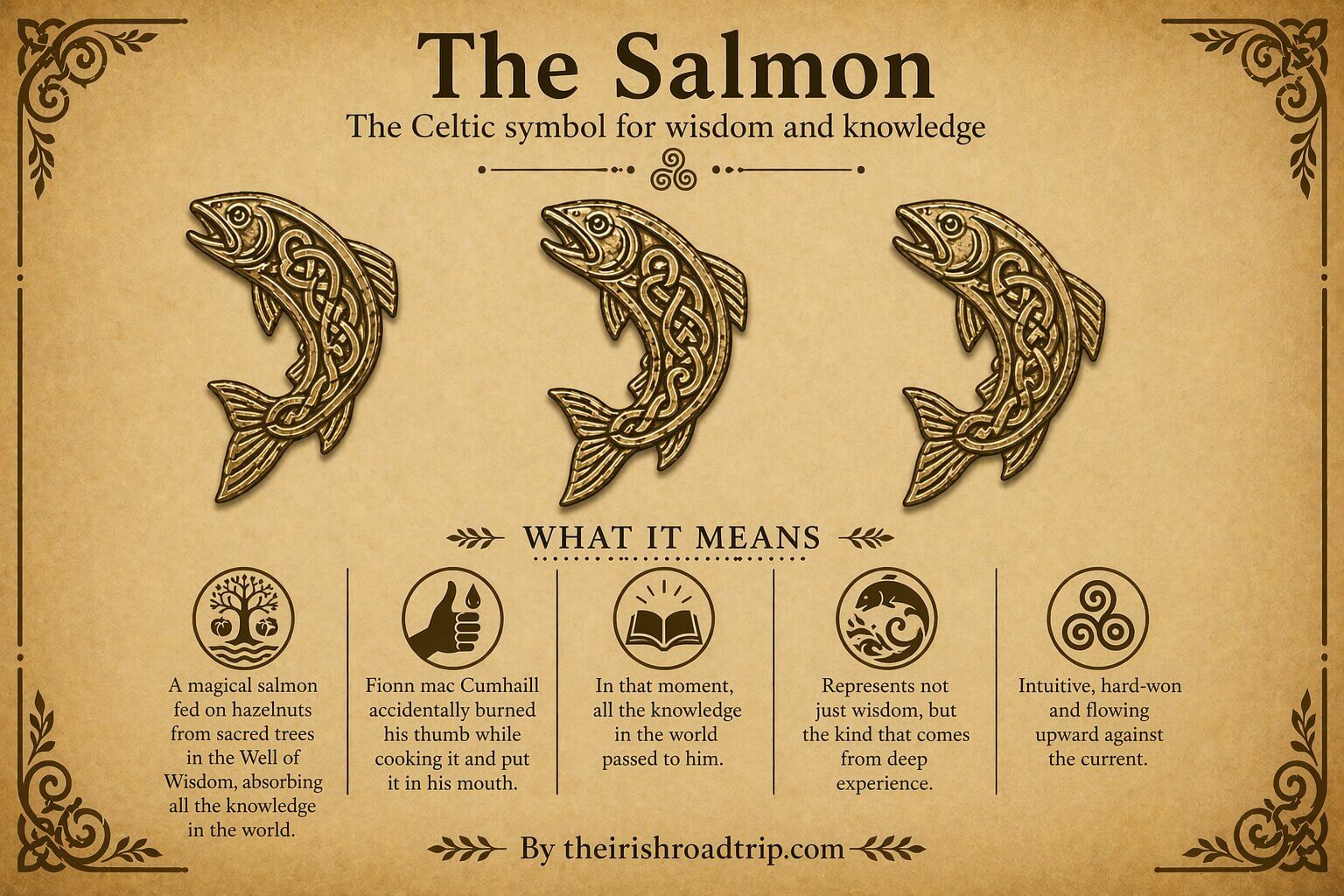
The salmon is the Celtic symbol for wisdom and knowledge. The Salmon of Knowledge is one of the most famous creatures in all of Irish mythology.
According to the legend, a magical salmon had fed for years on hazelnuts falling from sacred trees into the Well of Wisdom, absorbing all the knowledge in the world into its flesh.
The first person to taste it would receive that knowledge. That person turned out to be Fionn mac Cumhaill.
He was cooking the salmon for his druid teacher, Finnegas, when he burned his thumb on the skin and instinctively put it in his mouth. In that moment, all the knowledge in the world passed to him.
The Celtic Hound
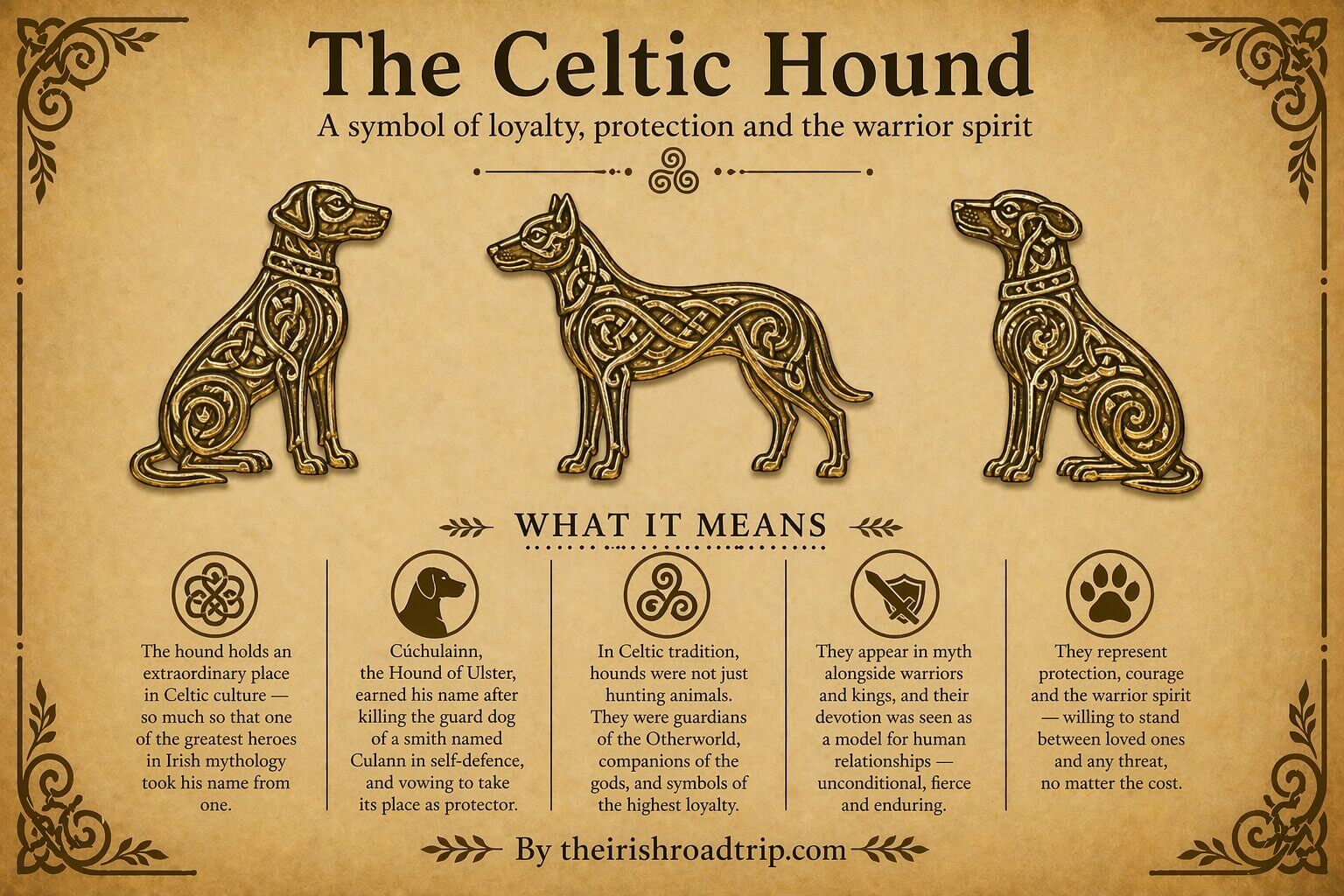
The hound holds an extraordinary place in Celtic culture, so much so that one of the greatest heroes in Irish mythology took his name from one.
Cúchulainn, the Hound of Ulster, earned his name after defeating the guard dog of a smith named Culann in self-defence, and vowing to take its place as protector.
In Celtic tradition, hounds were not just hunting animals. They were guardians of the Otherworld, companions of the gods, and symbols of the highest loyalty.
The Swan
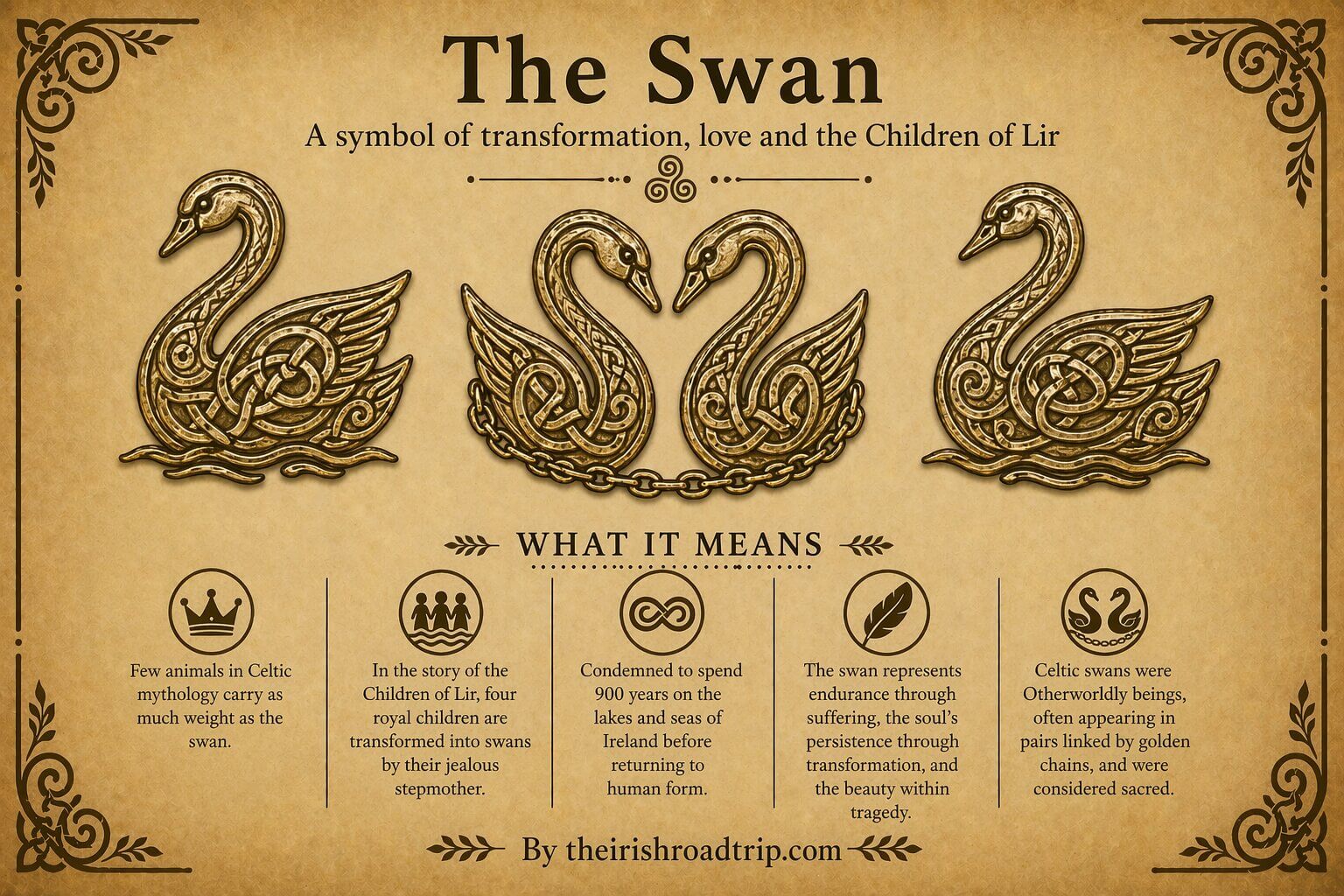
Few animals in Celtic mythology carry as much weight as the swan. In the story of the Children of Lir, four royal children are transformed into swans by their jealous stepmother and condemned to spend 900 years on the lakes and seas of Ireland before returning to human form.
The story gives the swan its primary Celtic associations: endurance through suffering, the soul’s persistence through transformation, and the heartbreaking beauty that can exist within tragedy.
Celtic swans were Otherworldly beings, often appearing in pairs linked by golden chains, and were considered sacred.
The Wolf
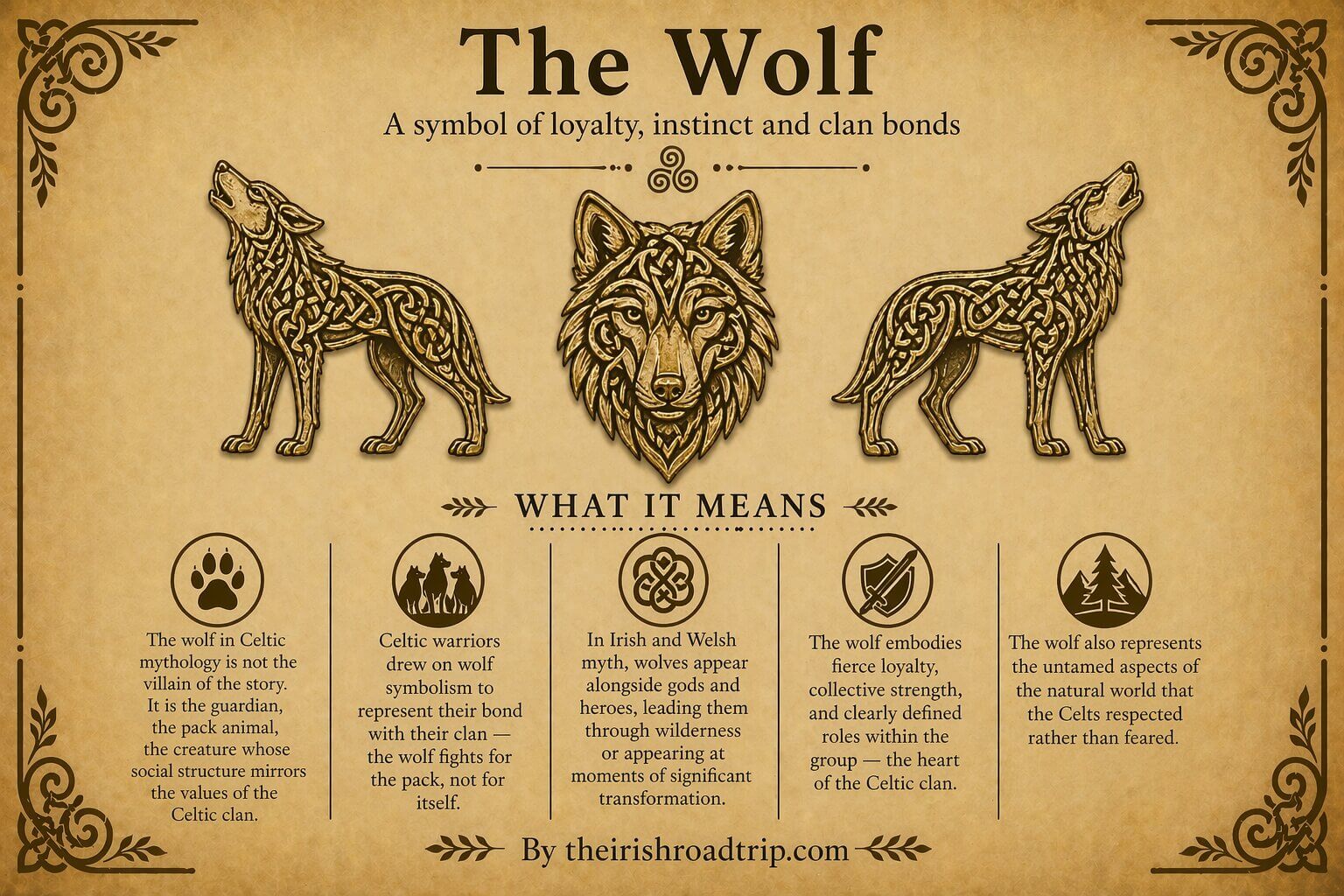
The wolf in Celtic mythology is not the villain of the story. It is the guardian, the pack animal, the creature whose social structure mirrors the values of the Celtic clan: fierce loyalty, collective strength and clearly defined roles within the group.
Celtic warriors drew on wolf symbolism to represent their bond with their clan – the wolf fights for the pack, not for itself.
In Irish and Welsh myth, wolves appear alongside gods and heroes, leading them through wilderness or appearing at moments of significant transformation.
The wolf also represents the untamed aspects of the natural world that the Celts respected rather than feared.
The Serpent
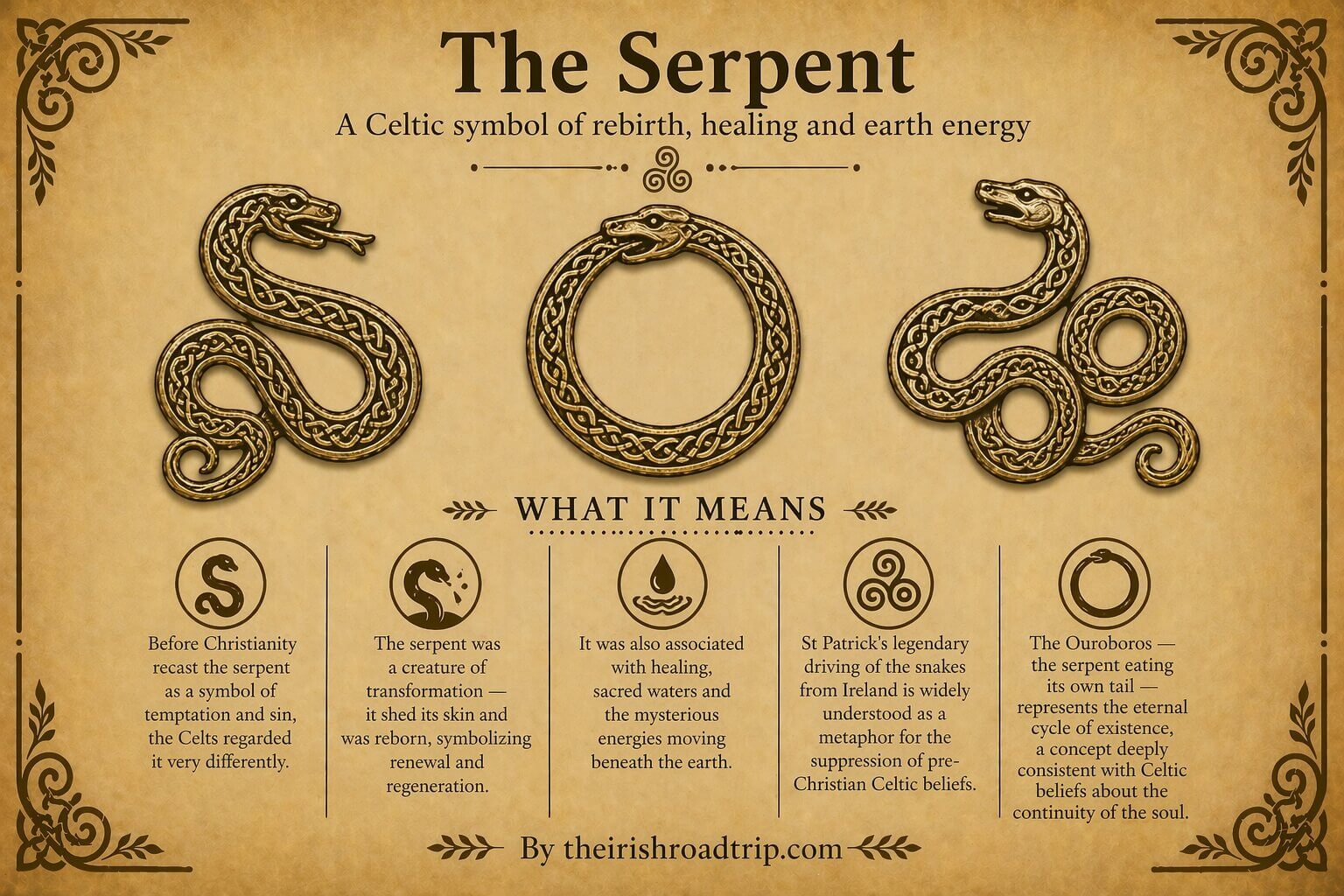
A Celtic symbol of rebirth, healing and earth energy. Before Christianity recast the serpent as a symbol of temptation and sin, the Celts regarded it very differently.
The serpent was a creature of transformation – it shed its skin and was reborn, making it a natural symbol of renewal and regeneration.
It was also associated with healing, sacred waters and the mysterious energies moving beneath the earth.
Snakes were never native to Ireland, but serpent symbolism very much was. The Ouroboros – the serpent eating its own tail – represents the eternal cycle of existence, a concept deeply consistent with Celtic beliefs about the continuity of the soul.
The Horse / Epona
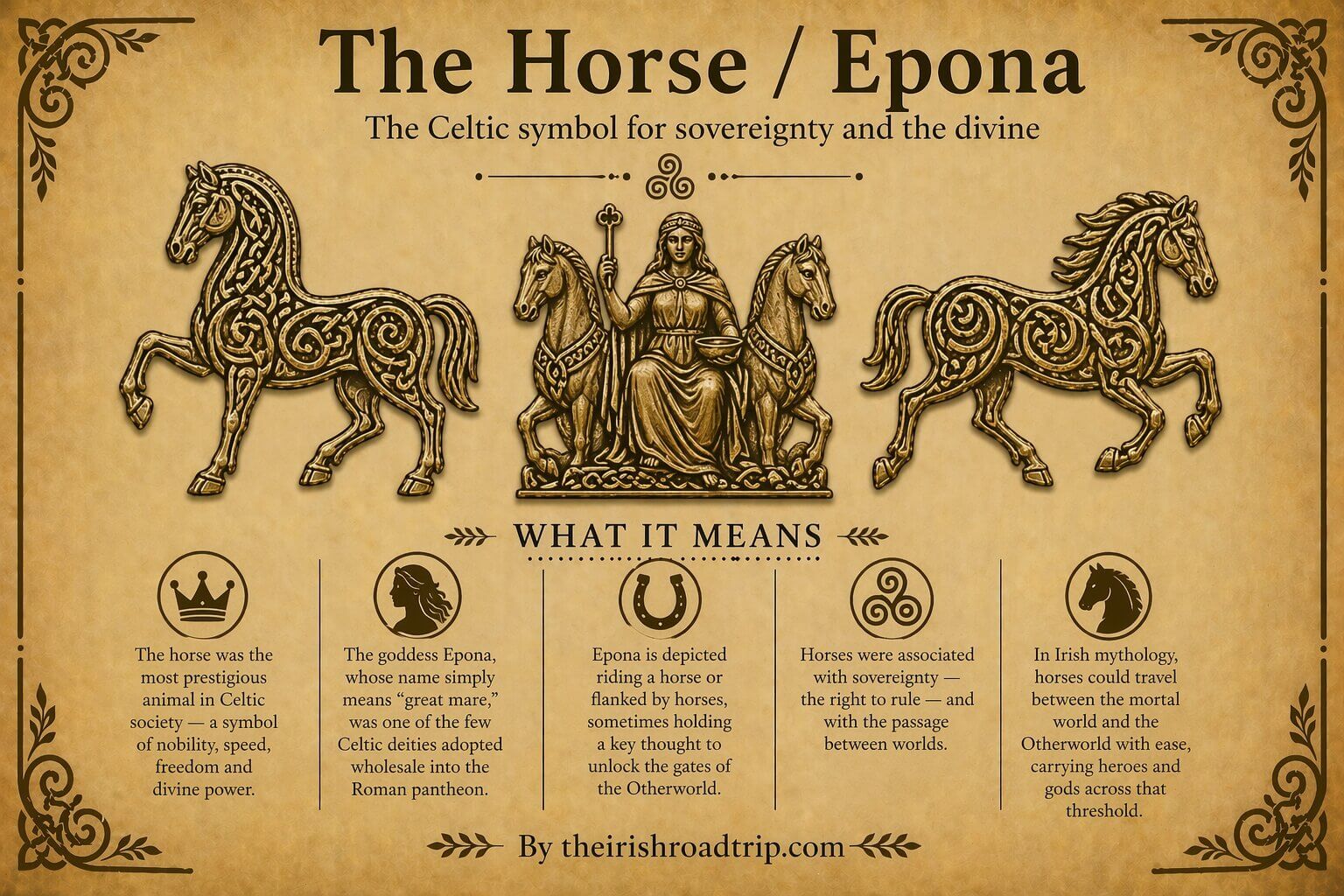
The Celtic symbol for sovereignty and the divine. The horse was the most prestigious animal in Celtic society – a symbol of nobility, speed, freedom and divine power.
The goddess Epona, whose name simply means “great mare,” was one of the few Celtic deities adopted wholesale into the Roman pantheon, where she was worshipped by cavalrymen across the empire.
Epona is depicted riding a horse or flanked by horses, sometimes holding a key thought to unlock the gates of the Otherworld.
Horses were associated with sovereignty (the right to rule) and with the passage between worlds. In Celtic mythology, horses could travel between the mortal world and the Otherworld with ease, carrying heroes and gods across that threshold.
The Boar
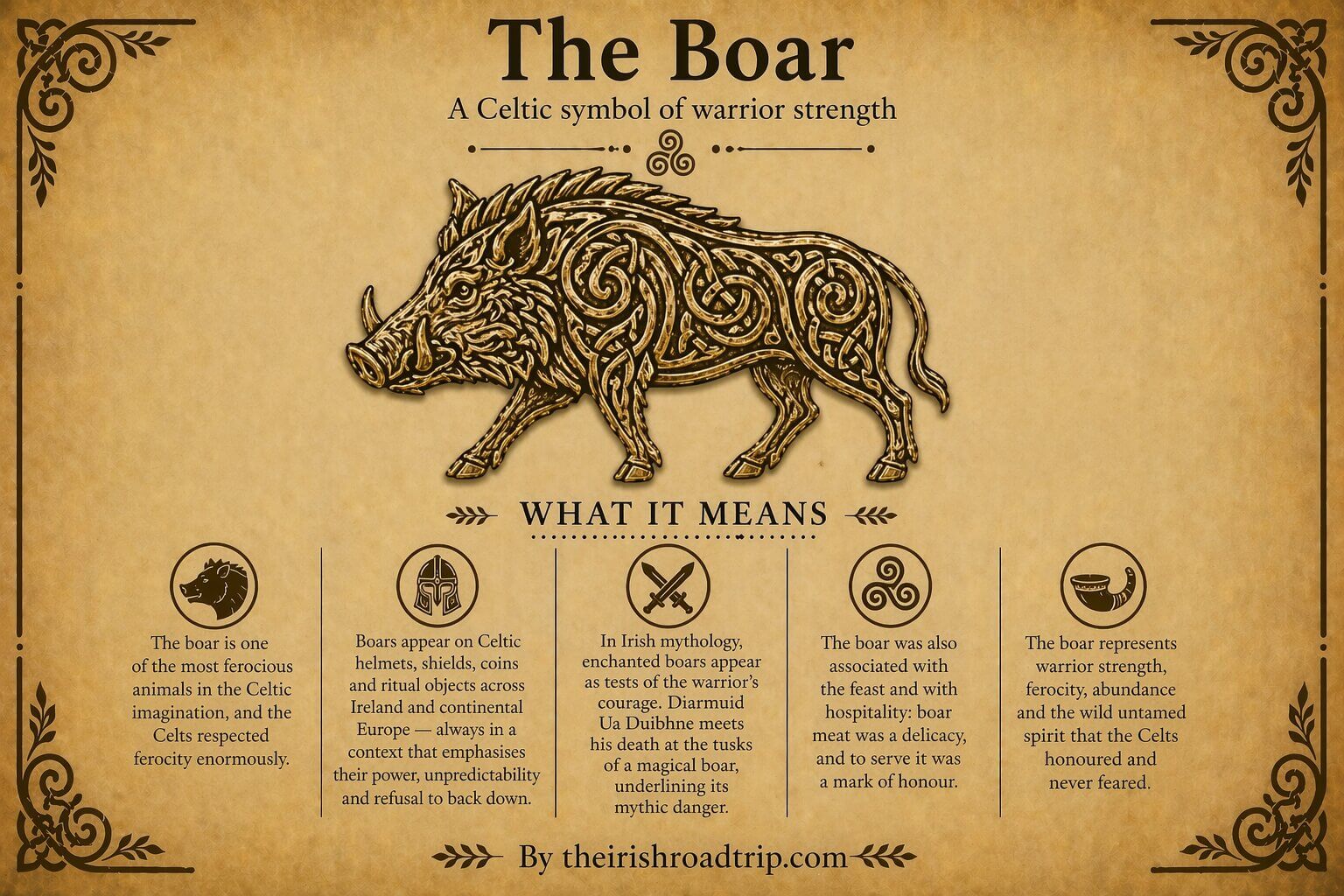
A Celtic symbol of strength, the boar is one of the most ferocious animals in the Celtic imagination, and the Celts respected ferocity enormously.
Boars appear on Celtic helmets, shields, coins and ritual objects across Ireland and continental Europe – always in a context that emphasises their power, unpredictability and refusal to back down.
In Irish mythology, enchanted boars appear as tests of the warrior’s courage. Diarmuid Ua Duibhne, one of the most celebrated heroes of the Fianna, meets his end at the tusks of a magical boar, in a story that underlines the creature’s mythic danger.
Irish Celtic symbols and their meanings chart
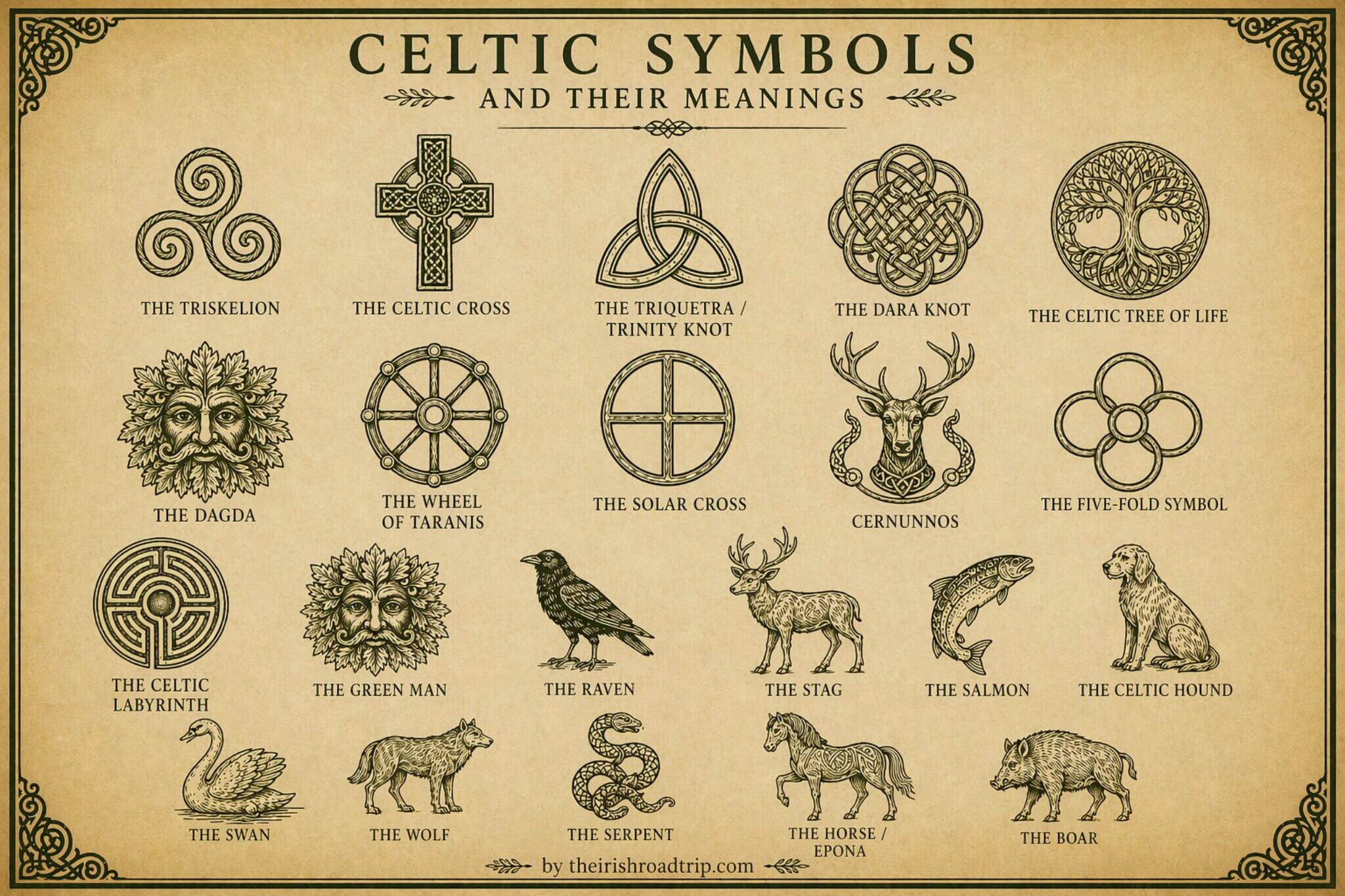
Celtic symbols and meanings chart
The Celtic symbols and meanings chart above is a handy reference point if you would like to compare the different designs side-by-side.
As you can see, many of the Celtic designs are similar in ways, with the interwoven aspect reappearing time and time again.
The history of Celtic symbols
Celtic designs arrived in Ireland with the Celts. The Celts were an indigenous race that lived in groups across Northern Europe from pre-500BC to the Medieval Period.These ancient people lived in small tribal communities and, despite being widely scattered, they spoke similar Celtic languages and had many common cultural symbols.
One of the groups among the ancient Celts were the Druids. Druids were among the high-ranking professional, religious and law-keeping members of Celtic culture.
Consequently, Druid symbols have a close association and overlap with many ancient Celtic symbols and meanings. Irish symbols, like the harp, are in no way connected to the Celts.

Keith O’Hara has lived in Ireland for 35 years and has spent much of the last 13 creating what is now The Irish Road Trip guide. Over the years, the website has published thousands of meticulously researched Ireland travel guides, welcoming 40 million+ visitors along the way. In 2022, the Irish Road Trip team published the world’s largest collection of Irish Road Trip itineraries. Keith lives in Dublin with his dog Toby and finds writing in the 3rd person minus craic altogether.
Leah
Wednesday 25th of September 2024
Thank you for this! I read a lot of bunk online, and when I visited Ireland years ago, I asked many people about this. I got different answers, but most were online with what you wrote.
A N
Sunday 20th of March 2022
Thanks! It's nice to learn about the Celtics! So much has been lost or corrupted...
Ricky
Thursday 17th of March 2022
i love the article! I'm curious about druids. I've read about them and it says that they come from somewhere called Gaul but that's in France (I'm not sure, i can't remember if that's true or not.) was Gaul originally in ancient Ireland or was it something else?
Christine
Saturday 12th of March 2022
This was fantastic. Thanks for the education!
Lilu
Thursday 12th of August 2021
Thanks for the information, I loved it